
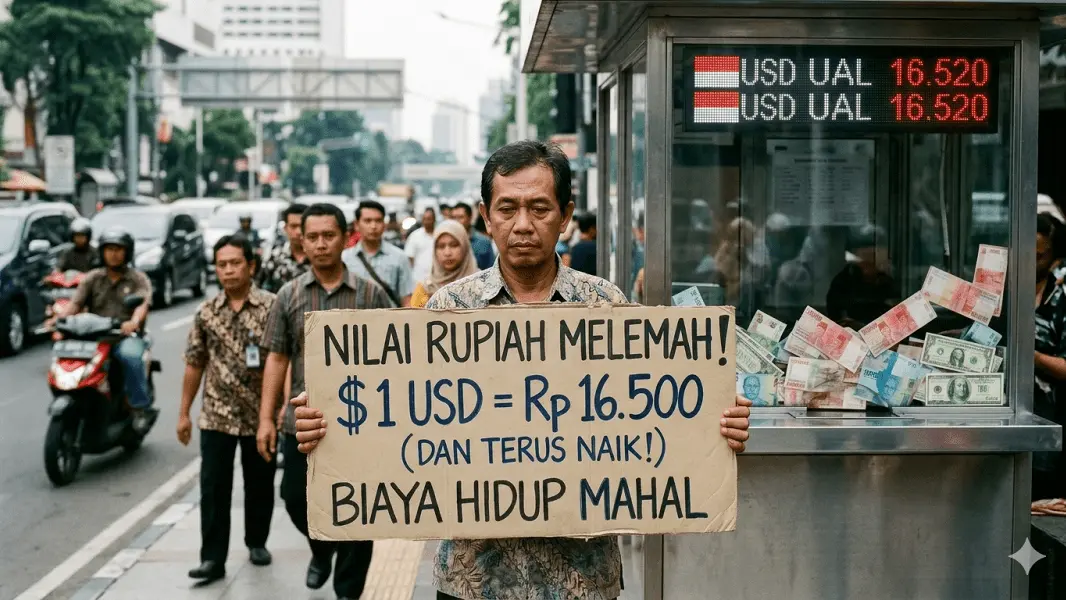
Recently, we have been frequently presented with quite worrying news about the rupiah's continued decline, reaching Rp 17,700 per US dollar on Monday, 25 May 2026. Year-to-date (YTD) since early 2026, it has fallen 5.99 percent. Since October 2024, the rupiah has depreciated by around 12 percent, from around Rp 15,400 per US dollar.
If we look more closely, there are actually many factors contributing to our currency's current predicament. Global geopolitical tensions between the United States and Iran in the Middle East have triggered a surge in global oil prices, surpassing US$108 per barrel.
This situation is particularly pressing because Indonesia remains a major oil importer, resulting in a drastic increase in the need for dollars to pay for energy. The government has also played a role in maintaining fuel prices by providing subsidies and energy conservation measures, which by the end of March 2026 had reached Rp 118.7 trillion.
But not only that, the state budget is also experiencing a deficit. State spending in the first quarter reached IDR 815 trillion, while revenues only came in at IDR 574.9 trillion. This situation is further exacerbated by import growth of 10.05 percent, while exports only increased by 0.34 percent. This means we need far more dollars to pay for the goods we buy from abroad, while our ability to generate dollars from exports has barely budged.
With our weakening economy, it's no surprise that the US Federal Reserve's high interest rate policy has caused foreign capital to flow out of our domestic market in search of more secure profits there.
From an Islamic economic perspective, this situation is seen as an economic risk that requires fair and ethical management to maintain balance within society. Islam strongly emphasizes avoiding excessive speculation and unnecessary protectionism, as these will only create prolonged economic instability.
As a concrete step, Islamic economics encourages strengthening real sectors such as agriculture and the manufacturing industry to strengthen the nation's independence, preventing us from becoming unsustainably dependent on foreign products or capital, which are highly vulnerable to global turmoil.
Furthermore, mechanisms for protecting Sharia values through legitimate agreements (kad) are available to help businesses minimize risk without becoming trapped in interest or usury practices. The role of social instruments such as productive waqf and zakat is also crucial as an economic cushion for those most impacted, preventing further decline in their purchasing power.
The government also holds a significant responsibility to ensure that policies taken genuinely support the welfare of the people through equitable distribution of wealth and targeted subsidies. Ultimately, true stability, from an Islamic perspective, is the presence of a sense of security and the equitable fulfillment of people's basic needs.