
-Registry-Issuance-(21)-converted.png)
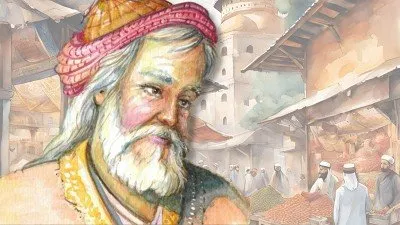
Sheikh Prof. Dr. Yusuf al-Qaradawi is one of the most influential Islamic scholars of the contemporary era. He has published more than 120 books, among his most popular works being Min Hady al-Islam Fatawa Mu’asirah, Fiqh al-Zakat, and Al-Halal wa al-Haram fi al-Islam. He has also received eight international awards for his contributions to Islamic scholarship. However, behind his transformative thinking on Islamic economics, there is another, more important aspect to understand: how his life experiences shaped his thinking and later influenced his ideas.
Yusuf al-Qaradawi was born in a small Egyptian village called Shafth Turaab in the middle of the Nile Delta in 1926. From a young age, he demonstrated a deep interest in Islamic studies and had memorized the Quran by the age of 10. However, his intellectual journey was not smooth. Qaradawi received a prison education from a young age. During the rule of King Faruk of Egypt, he was imprisoned in 1949 at the age of 23 for his involvement in the Muslim Brotherhood movement. This experience shaped his thinking, emphasizing that religion can never be truly separated from social reality.
Yusuf Al-Qaradawi graduated from Al-Azhar University in 1952 but only received his doctorate in 1972. This delay in obtaining his degree was due to his being entrusted with developing secondary and higher education in Qatar in 1961. In 1973, he successfully established the Faculty of Sharia and Islamic Studies at Qatar University and served as its dean until 1990, while also leading the Center for Hadith Studies and the History of the Prophet at the same university.
One of Qaradawi's most prominent aspects was his view of knowledge. He rejected the dichotomy between religious and general knowledge, viewing the two as complementary parts of a whole. This attitude was evident not only in his ideas but also in his practical life, including the educational freedom he granted his children in various fields of knowledge. Qaradawi consistently emphasized that openness to modern knowledge did not necessarily conflict with Islamic principles.
This approach was reflected in his methodology. Qaradawi was known for his concept of moderation, or wasathiyah, which balances normative texts with the dynamics of reality. He strove to uphold the basic principles of sharia while allowing for adaptation to social, economic, and technological changes. This approach made his thinking relatively accessible in various contexts, including the modern world.
This is evident in his views on zakat. For Qaradawi, zakat, in addition to being a ritual obligation, also serves as a socio-economic instrument that plays a crucial role in alleviating poverty. Although the poor are included in the asnaf (eligible recipients) of zakat, in his view, not all are entitled to receive zakat. The poor who are entitled to receive zakat are those whose poverty is caused by forced unemployment or the inability to meet all their living needs despite working. However, if the poverty is due to someone who is able to work but instead chooses to sit back and be lazy, according to him, that group is not entitled to zakat.
Furthermore, he emphasized that zakat is not merely consumptive; it must be directed toward productive purposes to foster the economic independence of those entitled to it. In his book, he also provides insights into the principles of distribution, ensuring that it does not focus solely on consumptive or productive zakat. Therefore, in his view, individuals who are entitled to consumptive zakat are those who are physically incapable of working. However, those who have the ability and health and are unemployed due to forced unemployment are entitled to receive consumptive zakat.
In his ideas, Qaradawi also developed the concept of zakat to make it relevant to the modern economic context. He expanded the scope of zakat objects to include professional income, investments, and other contemporary economic sectors. This approach is based on the principle that zakat must keep pace with the development of society's wealth resources. In a modern economy, where income is no longer confined to traditional sectors, distribution instruments such as zakat also need to adapt.
However, this idea is not free from debate. The concept of professional zakat, for example, remains a topic of debate among Islamic scholars because it is considered to lack an explicit textual basis. Some accept this approach.
Some consider the benefit of the community, while others are more cautious in accommodating such expansion. This demonstrates that Qaradawi's thinking is open to further study and not rigid.
Ultimately, Qaradawi's contribution lies in his efforts to maintain the relevance of Islamic law amidst changing times. He not only maintained the classical heritage but also sought to connect it to contemporary realities. This is where it is crucial to understand his thinking, that fiqh is not viewed simply as a rigid body of laws, but rather the result of the interaction between text, context, and the ever-evolving needs of humankind.
-Registry-Issuance-(19)-extra_small.png)
-extra_small.png)