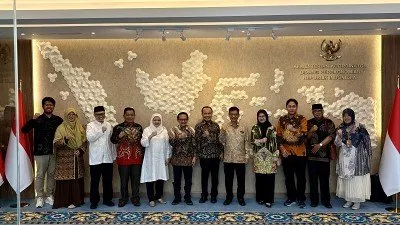

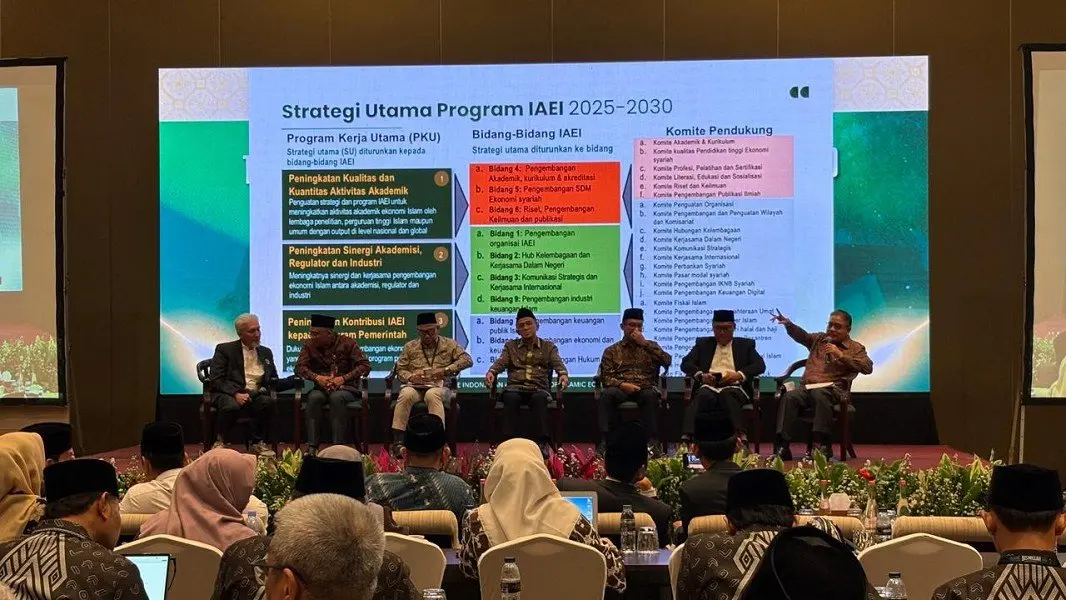
The Executive Chairman of the Indonesian Islamic Economists Association (IAEI), Muhammad Syakir Sula, attended and conveyed congratulations from representatives of Islamic economic associations at the DSN-MUI Management Introduction for the 2025-2030 Term, Wednesday, February 12, 2026, at the Sultan Hotel, Jakarta. The presence of IAEI in this forum is part of efforts to strengthen synergy between fatwa authorities and the academic community and Islamic economic experts.
In his presentation, the Executive Chairman emphasized that the synergy between IAEI and DSN-MUI has a strong strategic foundation, especially in terms of strengthening scientific and policy bases. The collaboration is directed at data-based cooperation, academic studies, and strengthening public literacy on Islamic economics and finance. “There is much that we can collaborate on between IAEI and DSN, especially in matters related to research, literacy, and government policy-making. There are many human resources, research, and studies that can be collaborated on,” said Syakir Sula.
IAEI, as a professional organization that brings together academics, practitioners, and researchers in Islamic economics, views the momentum of the new DSN-MUI management as an opportunity to align research with national policy needs. This synergy is expected to strengthen the quality of policy recommendations while ensuring that the implementation of sharia principles remains relevant to the dynamics of the modern economy.
Furthermore, he also conveyed the mandate of the Chairman of IAEI and Minister of Religious Affairs of the Republic of Indonesia, Prof. Dr. KH. Nasaruddin Umar, MA. to prepare a concept for the Central Office of the Ummah Da'wah Development Institute (LPDU). The concept is designed as a center for coordination and strengthening of the ummah movement in an integrated manner, with the hope of accelerating the consolidation of strategic thinking and action across organizations. “We at IAEI have also been tasked by the Chairman to prepare a concept for the Central Office of the Ummah Da'wah Development Institute, where all Islamic mass organizations, including MUI, will have their offices,” he explained.
On the same occasion, Prof. K.H. Ma'ruf Amin also emphasized the urgency of sharia economics in providing benefits to the ummah. He reminded that the Islamic economics movement must continue to be intensified so that it can become a pillar of equitable and sustainable national development. “The Islamic Economics Movement began 25 years ago. Let's intensify it to socialize Islamic economics and make society more Islamic,” said KH. Maruf Amin.
As a follow-up to this spirit, IAEI is committed to strengthening strategic collaboration in driving the agenda of socializing Islamic economics and making the community's economy more Islamic. This synergy does not only stop at the level of fatwas and academic studies, but is also manifested in a national literacy movement, strengthening the capacity of business actors, assisting the halal industry, and compiling research-based policy recommendations that are applicable. With the authority of the MUI and the scientific network of experts at IAEI, it is hoped that the Islamic economy will no longer be an exclusive discourse but will become the mainstream of inclusive, equitable national development that brings benefits to all Indonesian people.