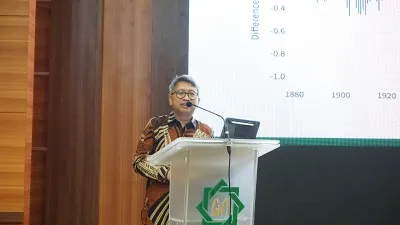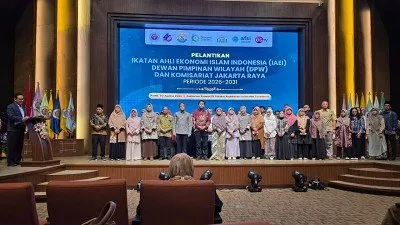

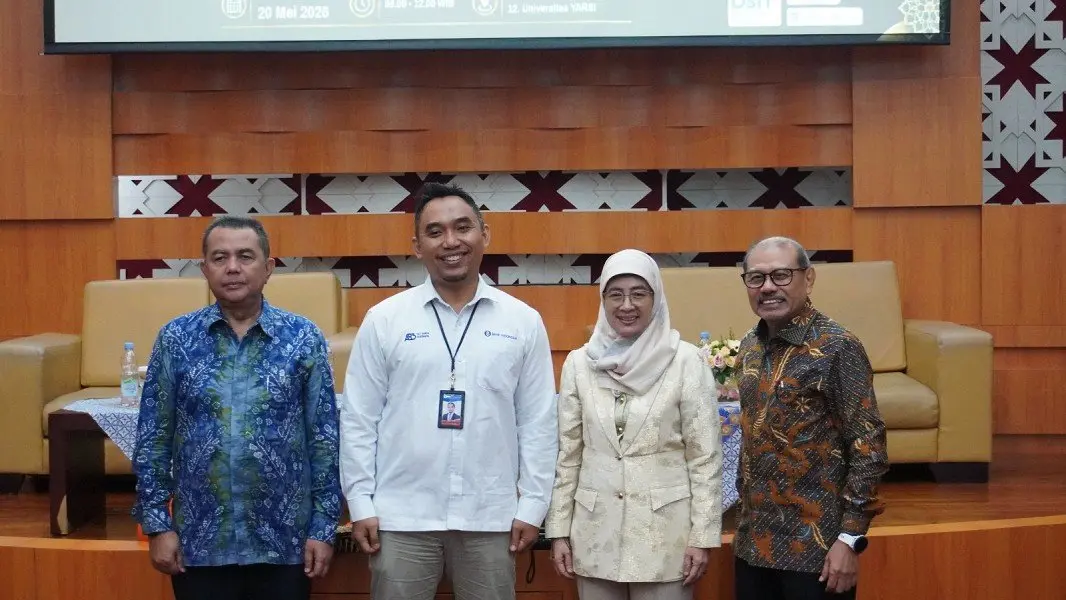
The IAEI National Seminar, YARSI University Commissariat, presented several strategic presentations on the direction of Indonesia's sharia economy on Wednesday, May 20, 2026, at the Al-Quddus Auditorium, 12th floor, Yarsi University. One of the speakers was Prof. Dr. Nurul Huda, S.E., M.M., M.Sc., Deputy Chair for Academic Development, Curriculum, and Accreditation, who also serves as Vice Rector IV of YARSI University. He thoroughly explored the potential and challenges of waqf as a strategic instrument for driving the Indonesian economy.
He opened the discussion by highlighting the vast potential of national waqf, but unfortunately, its realization is still far from optimal. Data shows that national waqf assets currently number 435,768 locations, and as of April 2026, there had been 366,595 waqf land certificates covering a total area of 277,203 hectares. Based on analysis, Indonesia is even recorded as having the largest waqf assets in the Islamic world. However, despite this large figure, serious risks remain, including legal disputes, idle assets, and low productivity of existing waqf assets.
"Unfortunately, despite the enormous potential of waqf assets, 65% are still in the form of mosques and prayer rooms," stated Prof. Nurul Huda, thus, waqf has not optimally contributed to driving economic growth for the community. He further stated that the potential for national waqf assets is above IDR 2,000 trillion, with cash waqf potentially exceeding IDR 180 trillion. However, to date, the realization of cash waqf has only reached IDR 3.3 trillion by 2025, only around 1.6% of the true national potential. "When integrated with commercial and social Islamic finance, the impact is truly enormous," he emphasized.
At the same seminar, Mohammad Nuryazidi, Ph.D., Executive Analyst at Bank Indonesia's Department of Islamic Economics and Finance (DEKS), also spoke as a resource person and explained Indonesia's position on the global Islamic economic map and the strategies currently being implemented by Bank Indonesia.
Nuryazidi highlighted Indonesia's achievements based on the State of the Global Islamic Economy (SGIE), which ranked Indonesia third in the world behind Malaysia and Saudi Arabia, with the modest fashion segment even ranking first. "Our textiles are quite popular because of our excellent ideas. Made in Indonesia textiles are highly respected and favored by global consumers," he said.
However, the ambition to become number one in the global Islamic economy must contend with challenging global conditions. Nuryazidi presented several data points reflecting the latest global dynamics, from the drastic decline in shipping traffic in the Strait of Hormuz, the continued rise in oil prices, to the downward revision of the global economic growth projection to 3.0 percent. "This means we are enthusiastic about becoming number one, but the global challenges are indeed quite significant," he said.
However, domestic conditions are showing more encouraging signs. Indonesia's Halal Value Chain (HVC) recorded 6.21% growth, halal-certified products showed consistent growth, and Islamic banking, which had experienced a slowdown, managed to rebound in the final quarter of 2025. "Although the global environment is quite challenging, from a sharia economic perspective, we are quite strong. However, greater efforts are needed," he emphasized.
Bank Indonesia itself supports this direction through three pillars of Islamic economic and financial policy: developing a globally competitive HVC, optimizing synergies between institutions, and increasing inclusion and literacy in the Islamic economy. Regarding literacy, Nuryazidi noted a gap that requires attention. "Our literacy rate is quite good, around 56 percent. But inclusion is only 13 percent," he said. To address these challenges, Bank Indonesia has prepared six strategic Islamic banking initiatives: Gerbang Santri (Santri Gate), Jawara Ekspor (Export Champion), Gema Halal (Halal Echo), Sapa Syariah (Sapa Syariah), Kanal Ziswaf (Waf Channel), and Lentera Emas (Golden Lantern), to realize Indonesia as a global center for Islamic economics and finance.
This National Seminar provided a platform that brought together academic, institutional, and policy perspectives on a single platform. Through Prof. Dr. Nurul Huda's presentation, which explored the vast untapped potential of waqf, and Bank Indonesia's presentation mapping the challenges and strategies of the Islamic economy at the global level, it was concluded that Indonesia possesses extraordinary potential, but requires closer synergy among all stakeholders to transform this potential into real strength. As a forum for Islamic economic intellectuals, the IAEI affirms its commitment to continuously fostering relevant ideas, policies, and movements that have a direct impact on the economic growth of the ummah and the advancement of the Indonesian Islamic economy on the global stage.