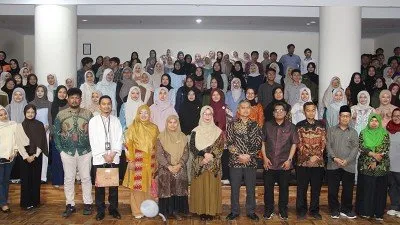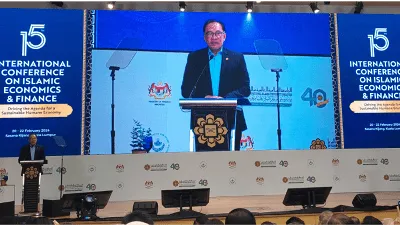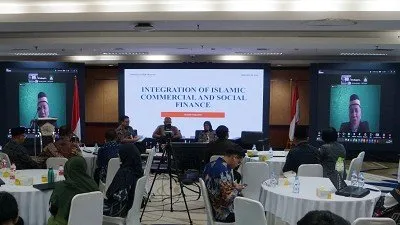

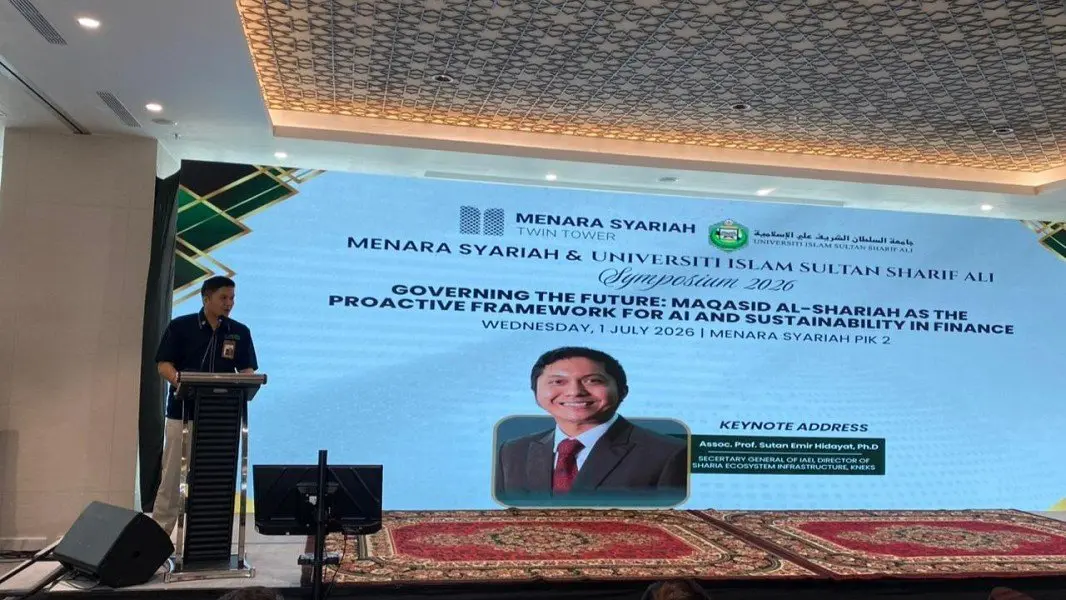
The development of Artificial Intelligence (AI) must be addressed proactively through governance grounded in the values of Maqasid Syariah to foster innovations that are not only efficient but also fair, inclusive, and oriented toward the public good. This was stated by Dr. Sutan Emir Hidayat, Secretary General of the Indonesian Association of Islamic Economists (IAEI), at the 2026 Symposium titled “Sustainability, Artificial Intelligence & Maqasid Al-Shariah in Finance: Reactive or Proactive,” held at Menara Syariah in collaboration with Sultan Sharif Ali Islamic University (UNISSA), Brunei Darussalam, Wednesday (July 1).
In his presentation, Dr. Sutan Emir, who also serves as Director of the Sharia Ecosystem Infrastructure at KNEKS, emphasized that the current challenge is not merely how to utilize AI to improve the efficiency of financial services, but rather how to ensure that this technology is developed from the outset with governance that upholds ethics, justice, transparency, and public welfare.
“The development of Artificial Intelligence should not be viewed merely as a technological revolution, but also as an opportunity to strengthen Sharia financial governance that prioritizes the public good,” said the IAEI Secretary-General.
Dr. Sutan Emir also explained that the Maqasid al-Sharia approach offers a more comprehensive perspective compared to the application of ESG principles. Through the protection of religion (hifz al-din), life (hifz al-nafs), intellect (hifz al-‘aql), property (hifz al-mal), and lineage (hifz al-nasl), Maqasid Syariah can serve as the foundation for governance that ensures digital transformation upholds the values of justice, consumer protection, inclusion, sustainability, and intergenerational well-being.
According to him, this approach shifts the paradigm from a reactive model toward proactive governance. AI should not merely be monitored after various risks emerge; rather, it must be designed from the outset based on principles of ethics, accountability, mitigation of harm (mafsadah), and optimization of public benefit (maslahah).
“The Islamic finance industry must not merely pursue digitalization; far more important is ensuring that digital innovation aligns with Sharia values, sustainability, and the public interest,” he added.
On that occasion, the IAEI Secretary-General also highlighted Indonesia’s significant potential to become one of the world’s hubs for the development of Islamic Sustainable Finance. Indonesia has demonstrated various important achievements through the issuance of the world’s first sovereign green sukuk, the development of Cash Waqf Linked Sukuk (CWLS), the strengthening of the Indonesian Sustainable Finance Taxonomy (TKBI), and the increase in Sharia-based green financing. However, various challenges—such as strengthening AI governance, harmonizing regulations, enhancing human resource capacity, and coordinating the ecosystem—still need to be addressed to further expand the economic impact of Sharia finance.
IAEI believes that collaboration among academics, regulators, the industry, and professional organizations is a key factor in building a Sharia economic and financial ecosystem that is adaptable to technological advancements without compromising fundamental Sharia values.
Through the 2026 Symposium, it is hoped that various strategic recommendations will emerge to strengthen responsible AI governance, accelerate the development of sustainable Sharia finance, expand research and innovation, and position Indonesia as a global reference in the development of Sharia economics and finance oriented toward the Maqasid al-Sharia.