
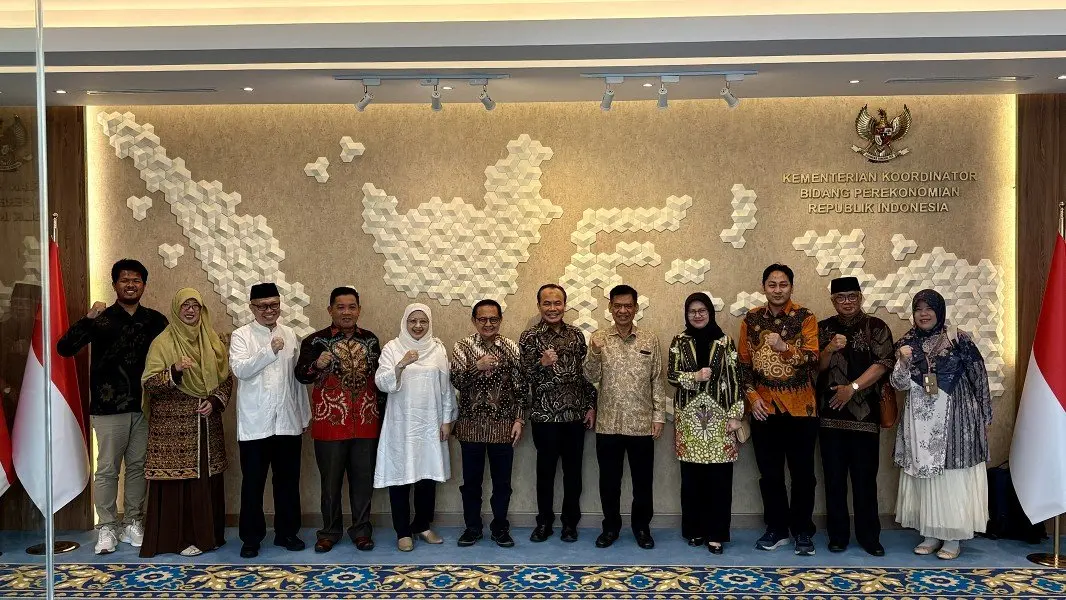
The Central Executive Board of the Indonesian Association of Islamic Economists (IAEI), in collaboration with the Coordinating Ministry for Economic Affairs of the Republic of Indonesia, organized a Focus Group Discussion (FGD) to discuss halal-related issues and the strategic implications of the Agreement on Reciprocal Trade (ART) between Indonesia and the United States. The event, held at the Ali Wardhana Meeting Room of the Coordinating Ministry for Economic Affairs in Jakarta, brought together government representatives and academics to discuss the impact of ART on national trade, industrial competitiveness, domestic component requirements (TKDN), halal certification, and cross-border financial transactions.
The Secretary of the Coordinating Minister for Economic Affairs, Susiwijono Moegiarso, explained that ART was the result of intensive economic diplomacy since 2025, following the United States’ reciprocal tariff policy that had the potential to impose tariffs of up to 32% on Indonesian export products. Through the agreement signed on February 19, 2026, these tariffs were successfully reduced to around 19%, with several strategic commodities receiving lower tariffs of up to 0%. Commodities benefiting from these facilities include crude palm oil (CPO), soybeans, coffee, cocoa, rubber, spices, as well as several industrial and electronic components. In addition, ART opens preferential trade facilities for 1,819 tariff lines, which are expected to enhance the competitiveness of Indonesian exports and provide benefits to labor-intensive industries such as textiles.
Susiwijono emphasized that various perceptions circulating among the public regarding ART, particularly concerning halal issues, do not fully reflect the substance of the agreement. He clarified that ART does not eliminate the halal certification requirement in Indonesia but rather regulates the recognition mechanism for foreign halal certification bodies that meet the standards set by Indonesia’s halal authorities. In this way, international trade can proceed more efficiently without compromising the protection of Muslim consumers.
In the discussion, Euis Amalia, Professor at UIN Syarif Hidayatullah and Head of the Human Resource Development Division for Islamic Economics and Finance at IAEI, highlighted the vast potential of Indonesia’s halal product market, which has attracted many trading partners. She emphasized that this potential must be managed carefully to avoid dependency on a single country while still protecting domestic business actors, including micro, small, and medium enterprises (MSMEs).
Didin Damanhuri, Vice Chairman of IAEI and Professor at IPB University, raised the issue of global geopolitical and economic dynamics. He explained that tariff instruments are often used as part of the economic strategy of major powers to expand their influence over trading partners. Nevertheless, he reminded that trade cooperation must be carefully analyzed to avoid leading to imbalances in the balance of payments or potential retaliation from other countries related to halal certification recognition.
Meanwhile, Telisa Aulia Falianty, Professor at the University of Indonesia, highlighted concerns regarding the security of cross-border financial transaction data as well as Indonesia’s position in international services trade, which still shows a deficit with the United States. She also discussed potential opportunities for cooperation in Islamic finance, including possible interest in Green Sukuk (SBSN) instruments.
Muhammad Hasan Gaido, a member of the Halal Industry and Hajj Ecosystem Development Committee of IAEI and also a board member of KADIN, emphasized that the ART issue is not solely related to the trade of goods but also involves dimensions of market intelligence. Therefore, he stressed the importance for academics to examine this issue comprehensively while ensuring that the public receives transparent information.
Another perspective was expressed by Achmad Kholiq, Professor at UIN Siber Syekh Nurjati, who noted that some public concerns arise from misunderstandings regarding halal certification issues within ART. He emphasized that international trade policies must be analyzed by considering the framework of maqashid shariah to ensure alignment with the objective of safeguarding public welfare.
Nur Rianto Al Arif, Professor at UIN Syarif Hidayatullah, highlighted the importance of public policy communication that is simpler and easier to understand. A similar view was expressed by Dian Masyita, Professor at Padjadjaran University, who stated that ineffective communication can intensify public concerns, particularly amid the current national economic condition that is facing fiscal pressures and deficits.
Meanwhile, Murniati Mukhlisin, Professor at Tazkia University, emphasized the importance of harmonizing halal standards between BPJPH and halal institutions in the United States such as IFANCA and ISA. This is considered necessary given the differences in institutional structures between the two countries, where Indonesia has clear halal regulations through Law No. 33 of 2014, while halal certification in the United States is managed by independent institutions.
Responding to these inputs, Susiwijono Moegiarso emphasized that the government will continue strengthening socialization efforts and dialogue with academics, halal industry actors, and community organizations so that public understanding of ART becomes more comprehensive. He also stressed that ART is not solely aimed at expanding export market access but also at strengthening bilateral economic cooperation and encouraging investment in strategic sectors such as critical minerals, energy, and technology, while also reinforcing Indonesia’s position in the global halal supply chain.
As a follow-up, the various inputs generated during the FGD will be consolidated by IAEI and brought to a broader forum at the IAEI Muzakarah. Through this forum, IAEI plans to formulate strategic recommendations for the government and business sector in navigating the dynamics of global economic cooperation, while ensuring that national interests and the strengthening of the Islamic economic and financial ecosystem remain safeguarded.