
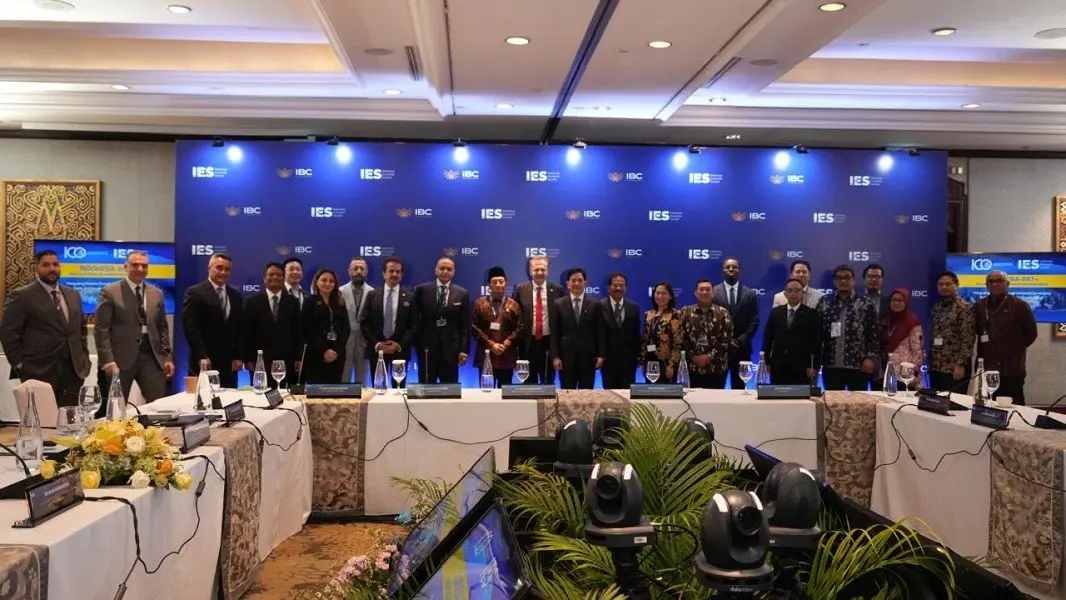
The Chairman of the Indonesian Association of Islamic Economists (IAEI) and Minister of Religious Affairs of the Republic of Indonesia, Prof. Dr. Nasaruddin Umar, M.A., was a speaker at the international forum Multilateral Business Roundtable Indonesia–B57+, Indonesia Economic Summit 2026 on Wednesday, February 4, 2026, at the Shangri La Hotel, Jakarta.
The Chairman explained Indonesia's strategic role as a hub for the global Islamic economy and emphasized the importance of integrating Islamic markets through strengthening cross-border connectivity, trade, and investment.
"Today we are gathered in a very important forum, the Indonesia-B57+ Multilateral Business Roundtable Forum, a strategic space to strengthen market integration through connectivity, trade, and investment in the Islamic world. Indonesia stands at the forefront of this effort, not merely through claims, but through tangible achievements recognized internationally,” said Prof. Nasaruddin at the Indonesia–B57+ Multilateral Business Roundtable, Indonesia Economic Summit 2026.
In the Global Islamic Economy Indicator (GIEI) 2024/2025, Indonesia maintained its third place ranking in the world, behind Malaysia and Saudi Arabia. The Chairman assessed that the B57+ initiative is in line with Islamic economic principles that emphasize justice, cooperation, and interconnection with the real sector.
Prof. Nasaruddin said that the contribution of the halal industry to the national economy continues to strengthen. In the third quarter of 2025, the Halal Value Chain (HVC) contributed 27.34 percent or the equivalent of IDR 4,832 trillion to the Gross Domestic Product. The government also prioritizes the digitization of halal certification through the SIHALAL system, which by December 2025 had recorded an accumulation of 10.99 million halal-certified products.
“The halal economy is one of the important drivers of the Indonesian economy. With a large and integrated market base from upstream to downstream, the halal economy is able to drive growth, expand access to financing, and increase Indonesia's competitiveness in the global value chain,” said Prof. Nasaruddin.
In addition to the real sector, the performance of the national Islamic finance sector continues to show a positive trend. Indonesia's Islamic finance market share reached 30.3% of total national financial assets (as of October 2025, KNEKS). Indonesia has also become the world's largest halal investment destination.
“Throughout 2023, there were around 40 halal investment transactions with a value of USD 1.6 billion, reflecting the increasing confidence of global investors in Indonesia's halal economic ecosystem and the enormous potential for cross-country collaboration,” said the Chairman.
Prof. Nasaruddin also stated that Indonesia's chairmanship of the D-8 for the 2026–2027 period will be utilized to expand halal economic diplomacy and strengthen Indonesia's position in the global value chain of halal products. “Indonesia is not just a player in the global Islamic economy; we want to be a partner that connects markets, facilitates investment, and opens up new opportunities for the shared prosperity of Islamic nations and the wider global community,” he concluded.
The forum was also attended by a number of figures and stakeholders from various sectors, including Sofyan A. Djalil as CEO of the Indonesia Business Council, Arsjad Rasjid as Founder and Chairman of Sriwijaya Capital and Chairman of the Board of Trustees of the Indonesia Business Council, the Islamic Chamber of Commerce and Development (ICCD), as well as delegates from various countries.