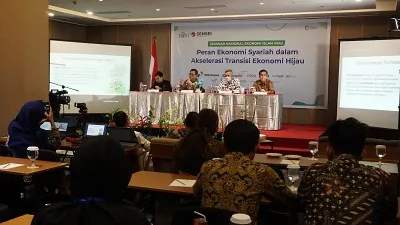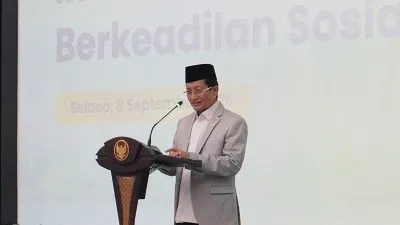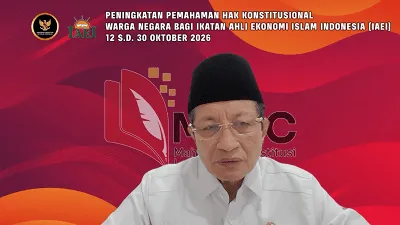

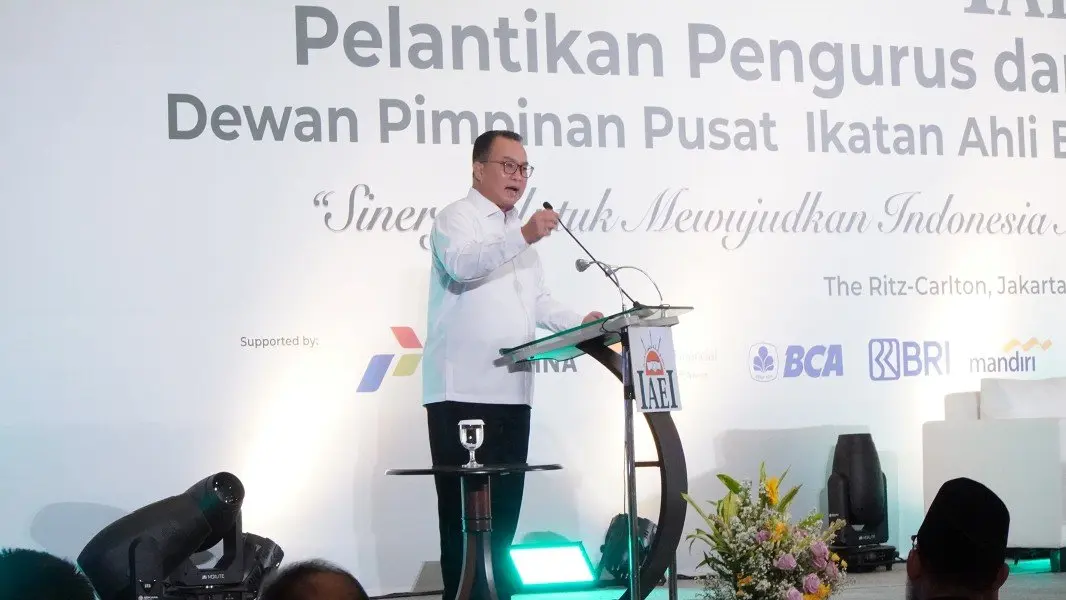
The Head of the National Research and Innovation Agency (BRIN), Prof. Arif Satria, was the keynote speaker at the National Working Meeting (Rakernas) of the Indonesian Islamic Economists Association (IAEI) on Friday (28/11) at The Ritz-Carlton Jakarta Ballroom. The Head of BRIN spoke at the prominent scholar session, discussing Strengthening Research as the Foundation for Sharia Economic Growth. In his presentation, BRIN explained the importance of research, technology, and innovation as the main drivers of improving the competitiveness of Indonesia's Islamic economy.
Prof. Arif Satria stated that the transformation towards an Innovation Driven Economy cannot be separated from improving the quality of human resources, research investment, and the creation of new technologies. He emphasized that various indicators of Indonesia's Global Innovation Index (GII) show significant improvements in private research spending, foreign R&D investment, and an increase in domestic patents for the period 2021-2025.
“Global data shows a strong correlation between innovation indices and economic growth. This means that research is no longer an option, but a necessity to achieve economic leaps,” he explained, referring to Paul Romer's endogenous growth theory.
To support the development of the sharia economy, BRIN outlined four major national research policy directions, starting from strengthening the capacity of science and technology human resources and research infrastructure governance; multi-stakeholder partnerships for research and innovation funding; research intermediation through KST, thematic hubs, and innovation networks; and downstreaming and widespread commercialization of research results.
These policies are designed to address the challenges of the halal economy, ranging from food, health, and energy to strengthening the knowledge-based economy. BRIN is also optimizing the role of Science and Technology Parks (KST) and Research Collaboration Centers (PKR) as innovation hubs in various regions.
Based on the State of Global Islamic Economy (SGIE) 2024/2025 report, Indonesia now ranks third in the global Islamic economic ecosystem and is targeting first place by 2029. Leading sectors such as Muslim fashion, Muslim-friendly tourism, pharmaceuticals, halal cosmetics, and halal food continue to show strong performance.
At the Rakernas forum, BRIN showcased a number of strategic innovations, including a halal and food freshness detection device based on rapid sensors; Food Saver Plasma, an energy-efficient food preservation technology without chemicals; and Electron Beam Machine, a modern irradiation facility that extends food shelf life and supports exports. These technologies have been patented or are in the process of being patented, and are an important component in the halal industry supply chain.
BRIN affirms its commitment to strengthening collaboration with IAEI and KNEKS, particularly in the preparation of the Sharia Economic and Financial Research Roadmap. IAEI views BRIN's contribution as an important part of efforts to strengthen the national Islamic economic architecture. The National Working Meeting serves as a strategic consolidation space to synergize research results, policy recommendations, and innovation downstreaming measures so that Indonesia's sharia economy becomes more globally competitive.