
The Chairman of the Indonesian Association of Islamic Economists (IAEI), Prof. Dr. Nasaruddin Umar, M.A., affirmed that Indonesia has a strategic position in the global arena, especially in building a new narrative about Islam through a fair and inclusive economic approach.
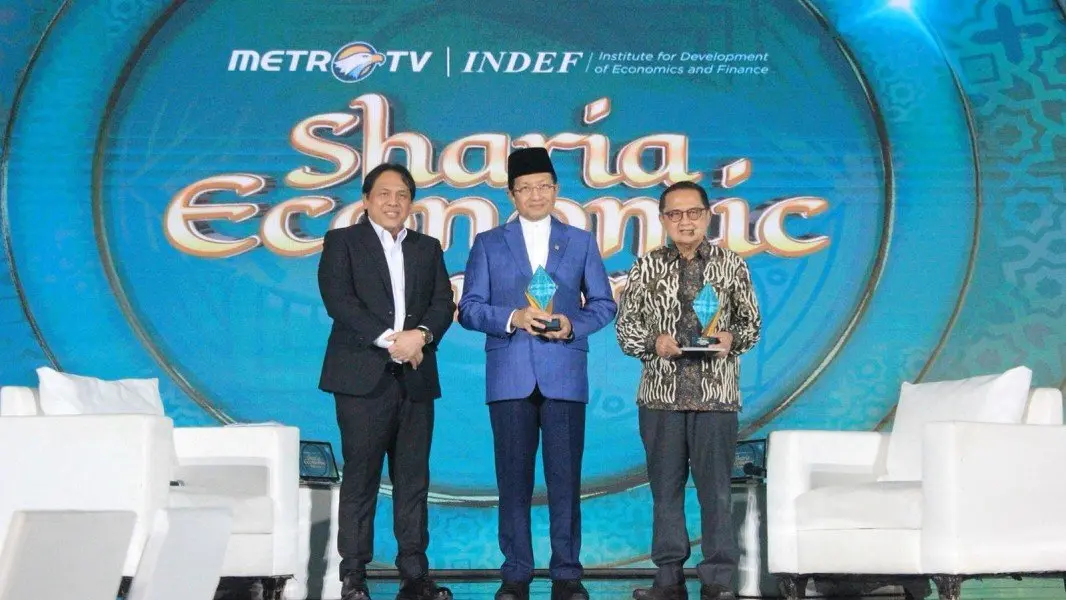
“Indonesia's presence can save the image of Islam in the world, which is commonly perceived as a rigid religion,” said Prof. Nasaruddin at the “Sharia Economic Forum 2026” event held by Metro TV on Thursday (February 12, 2026) at The Tribrata Darmawangsa, Jakarta.
In this forum entitled “Accelerating Growth and Prosperity: Path to Global Impact,” the Chairman highlighted the important space for reinforcing the grand direction of Indonesia's sharia economy. The Chairman, who is also the Minister of Religious Affairs of the Republic of Indonesia, shared his views in a special dialogue entitled “Promoting Indonesia as the Center of the World's Sharia Economy.”
Prof. Nasaruddin emphasized that sharia in the economic context is not related to any particular political ideology. The discussion of Islamic economics is actually related to democracy, pluralism, gender equality, human rights, and religious tolerance. Indonesia, with its high level of diversity, is considered successful in maintaining social harmony amid plurality of ethnicities, religions, and cultures. This condition is a strong social capital in building an economic system based on the value of justice.
“When we talk about sharia economics, it is truly an economic style that is forward-looking in terms of justice and enlightens the world. Sharia economics is not only beneficial for the Muslim community, but this concept of sharia is for everyone, how to create social justice, economic justice, and mutual benefit in overcoming various economic problems,” said Prof. Nasaruddin.
The Chairman's statement reflects the global reality that still harbors stereotypes about Islam. Through Islamic economics, Indonesia is considered capable of showing the rational, modern face of Islam, which is based on universal human values.
The Chairman also highlighted the development of Islamic economics as a global phenomenon. Countries such as Thailand and Japan, which are not predominantly Muslim, have shown significant growth in the halal and Islamic finance sectors. Even in Italy, halal products have become part of daily consumption, including in airline services. This phenomenon shows that the Islamic economy has transcended geographical and religious identity boundaries and is accepted as an economic system that offers stability and a commitment to social justice.
In the national context, Prof. Nasar emphasized that Indonesia, as the country with the largest Muslim population in the world, has a responsibility to set an example. Indonesia cannot just be a market for global sharia products and financial instruments. Indonesia must become a center of ideas, innovation, and best practices that other countries can refer to. He said that Indonesia should be a pilot project for the development of a sharia economy that is humanitarian and internationally competitive.
As Chairman of IAEI, Prof. Nasaruddin also highlighted the internal challenges that still need to be addressed. One of them is the aspect of literacy and strengthening knowledge about sharia in the context of the modern economy.
"As the chairman entrusted by my friends to lead the IAEI, there is one challenge that we must face, namely that we need to understand the knowledge of sharia. Understanding sharia is not only limited to fiqh muamalah, and the current economic world, especially banking, is developing rapidly. Therefore, the curricula of Sharia faculties that teach fiqh muamalah need to be integrated with the modern economy," he said.
Furthermore, Prof. Nasar revealed the enormous economic potential of the Muslim community that has not been optimally exploited. Internal calculations show that the economic potential of the Muslim community could reach around IDR 1,200 trillion per year if managed in a structured manner. "We have calculated that if we manage the Muslim community's economy alone, without considering other religions, we can collect IDR 1,200 trillion per year. For example, if people who save their money in banks with Islamic ID cards are required to pay all their zakat, IDR 327 trillion will be collected, whereas Baznas only collects IDR 41 trillion. So, we need to fix this. Waqf should even be richer than zakat," he said.
The Chairman also raised the idea of establishing a Community Fund Empowerment Institution (LPDU), which was mentioned by Indonesian President Prabowo Subianto as a coordinating umbrella for managing community funds. Currently, according to him, governance still has the potential for overlap because various institutions work separately. With a strong coordination system and structured supervision, the effectiveness of the distribution and empowerment of community funds can be significantly improved.
In closing his presentation, Prof. Nasar reiterated that the main principle of Islamic economics is humanity. Humanity is universal and transcends ethnic, racial, and religious boundaries. As long as the principles of social justice and economic balance are upheld, support will come from various groups, including non-Muslims who participated in the forum. Prof. Nasaruddin reminded the audience that the cultural and religious foundations of Indonesian society are important assets that can increase the confidence of global investors.
For IAEI, this forum is a momentum for consolidating ideas and strengthening Indonesia's position in the global Islamic economy. The challenges ahead lie not only in the growth of numbers and assets, but also in the consistency of building a system that is transparent, integrated, and oriented towards the public interest.
The Sharia Economic Forum 2026 is a strategic step to bring together regulators, academics, industry players, and stakeholders under one grand vision: to make Indonesia a competitive and humanitarian-oriented center for global Islamic economic development.