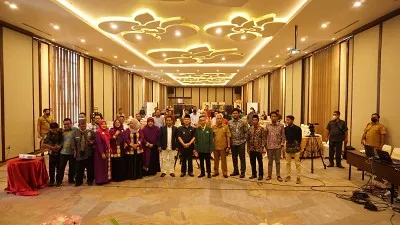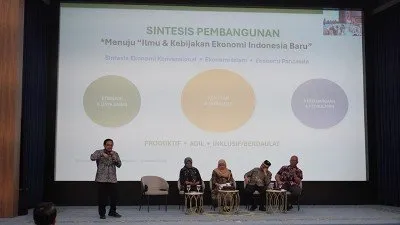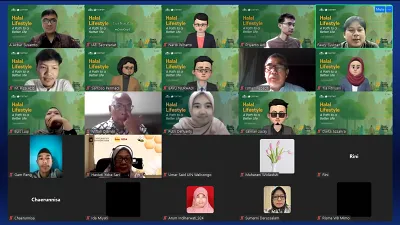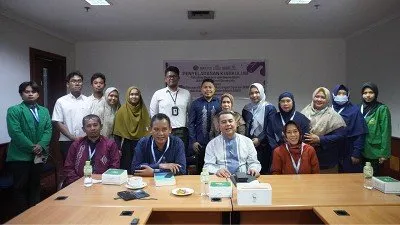

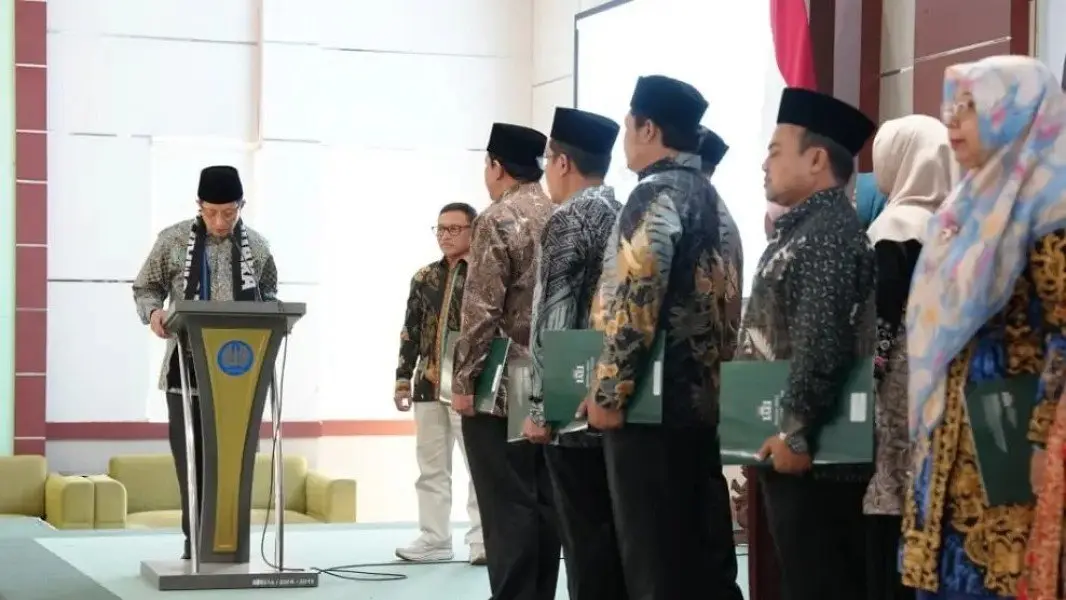
The Central Executive Board of the Indonesian Association of Islamic Economists (IAEI) is strengthening the Islamic economic development network in East Java by inaugurating the Regional Executive Board and 48 IAEI branches throughout East Java for the 2026–2031 term at Surabaya State University on Thursday (August 27). This organizational restructuring is aimed at expanding financial literacy, enhancing Islamic financial inclusion, and strengthening collaboration between universities and Islamic boarding schools in the development of the Islamic economy.
IAEI Chairman and Indonesian Minister of Religious Affairs, Prof. Nasaruddin Umar, stated that the development of the Islamic economy in East Java still faces challenges in the form of a gap between financial literacy and Islamic financial inclusion. Therefore, he believes that the Islamic financial literacy agenda needs to shift from merely raising awareness to bringing about behavioral change in society.
“We must guide society from ‘knowing’ to ‘understanding,’ from ‘understanding’ to ‘doing,’ and from ‘doing’ to ‘creating,’” said Prof. Nasaruddin.
Prof. Nasaruddin also encouraged universities to strengthen their contributions in generating innovations and Islamic economic solutions that can be applied in society. East Java is considered to have significant potential to become one of the national centers for Islamic economic development, with approximately 713 universities and 7,347 Islamic boarding schools that can serve as strategic assets in building an Islamic economic ecosystem.
Through this inauguration, the East Java Regional Chapter (DPW) of the Indonesian Association of Islamic Economists (IAEI) and its local chapters are expected to strengthen more tangible and impactful collaboration in the Islamic economy. The strengthening of the IAEI network in East Java is expected to bring together education, research, Islamic boarding schools, industry, policy, and community empowerment within an increasingly robust Islamic economic ecosystem.