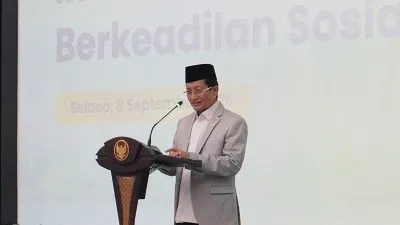

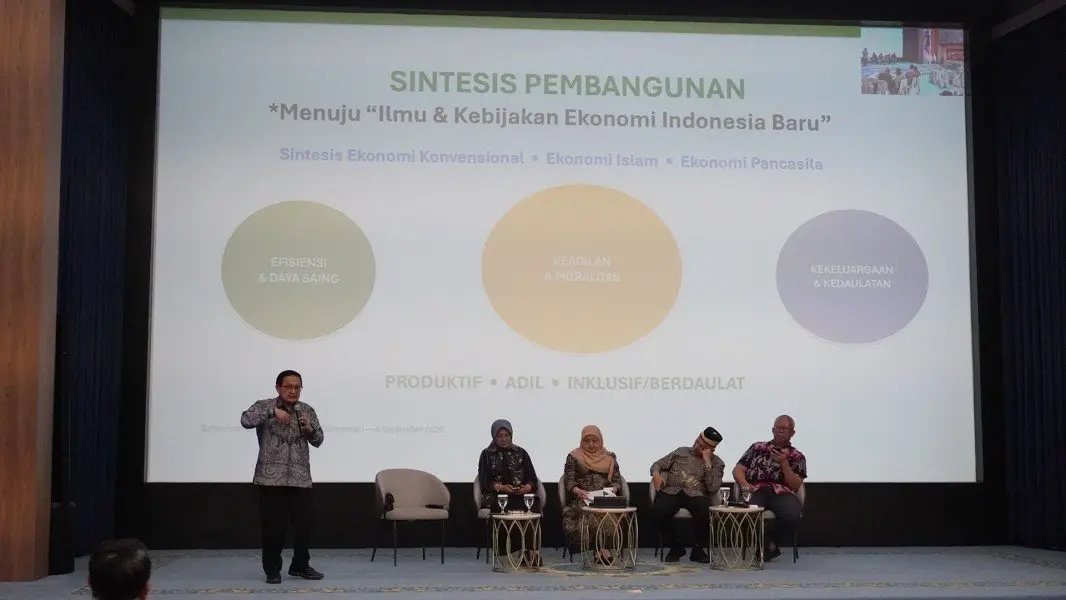
Prof. Didin S. Damanhuri, Vice Chair of the Indonesian Association of Islamic Economists (IAEI), believes that Indonesia’s economic development requires a synthesis of conventional economics, Islamic economics, and Pancasila-based economics to address the structural inequalities that still persist. According to him, these three perspectives each have their own contributions and limitations that need to be reconciled within the framework of national economic development. He made these remarks at the IAEI National Symposium on Tuesday (September 8) in the Graha Sawala Room, Ali Wardhana Building, Coordinating Ministry for Economic Affairs of the Republic of Indonesia, Jakarta.
Prof. Didin explained that conventional economics plays a vital role in promoting efficiency, productivity, and competitiveness, particularly at the micro level. However, at the macro level, this approach is deemed insufficient to address issues of asset concentration and economic power. Meanwhile, the development of Islamic economics in Indonesia has been empirically evident since the 1990s. Nevertheless, the Islamic economy still needs to expand its contribution from the financial sector to the real sector.
He highlighted the still-limited use of profit-sharing schemes such as musyarakah and mudharabah. “The Islamic economy should not only develop in the financial sector but must also be able to revitalize the real sector and strengthen the community’s economy,” said Prof. Didin in his presentation.
On the other hand, the Pancasila economy also faces challenges in its implementation. Prof. Didin assessed that the principles of kinship and partnership—which are integral to the Pancasila economy—have not yet been fully realized in practice. This is reflected, among other things, in the management of natural resources, which is deemed not to have fully brought prosperity to the people as mandated by Article 33, paragraphs (2) and (3) of the 1945 Constitution.
This disparity, he continued, is evident in the situation of approximately 36 million farmers who, on average, own only about 0.3 hectares of land, while large-scale land ownership is concentrated in sectors such as oil palm plantations, coal, and nickel. In addressing these issues, Prof. Didin emphasized two strategic agendas: agrarian reform and meaningful downstream processing.
Agrarian reform, he argued, is not sufficient if it is carried out solely through the redistribution or reorganization of land ownership. “Agrarian reform must be understood not merely as land reform, but also as a means for communities to gain access to capital, water, and other resources,” he said.
In the context of Islamic economics, he believes that the agrarian reform agenda can serve as a key area for contribution. The principles of justice and equity in Islamic economics can be realized by strengthening community access to productive resources while simultaneously promoting economic empowerment at the grassroots level.
In addition to agrarian reform, Prof. Didin emphasized the importance of downstream industrialization that is not only oriented toward attracting foreign investment but also ensures technology transfer and mastery of knowledge by Indonesian human resources.
Downstream industrialization, he argued, must be directed so that technology and intellectual property rights are controlled by Indonesians, involve MSMEs in the supply chain, and provide greater opportunities for local workers.
Prof. Didin’s ideas reinforce the IAEI’s discussion on the importance of finding common ground between conventional economics, Islamic economics, and Pancasila economics. It is hoped that the synthesis of these three approaches will not remain merely conceptual but can be translated into policies capable of strengthening the real sector, expanding access to economic resources, reducing inequality, and sustainably improving public welfare.