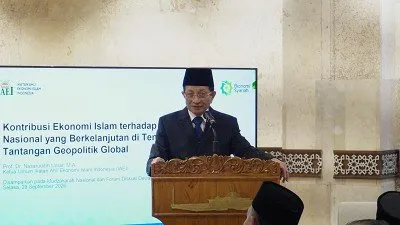

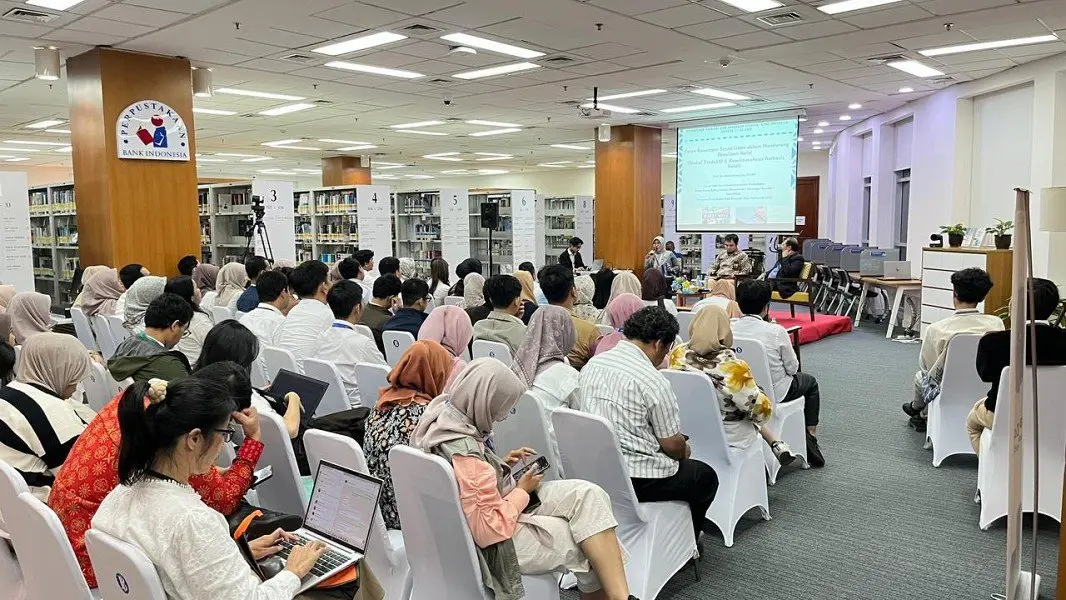
The Indonesian Association of Islamic Economists (IAEI) in collaboration with Bank Indonesia and the Bank Indonesia Library held a talk show entitled “Halal Around Us: Critical Points That Are Rarely Realized” on Wednesday, February 11, 2026, at the Bank Indonesia Public Library Lounge, Jakarta. During the forum, the Chair of the IAEI Law and Legislation Development Committee, Prof. Dr. Helza Nova Lita, was present as a guest speaker to discuss the role of Islamic social finance in promoting the strengthening of the halal ecosystem.
Prof. Helza, who is also a Professor of Sharia Economic Law at Padjadjaran University, emphasized that halal is a comprehensive concept. “When we talk about halal, it's not just about food or beverage products. Halal concerns the entire process, from raw materials, production, distribution, to the consumer,” he explained.
Prof. Helza then referred to Article 1 paragraph 2 of Law Number 33 of 2014 concerning Halal Product Guarantee, which defines halal products as products that have been declared halal in accordance with Islamic law. Furthermore, Article 4 of the same law stipulates that products that enter, circulate, and are traded in Indonesian territory must be halal certified. This means that this obligation has become a legal mandate.
From a consumer protection perspective, he also cited Article 8 paragraph (1) letter H of Law Number 8 of 1999 concerning Consumer Protection, which prohibits business actors from producing or trading goods without providing accurate and clear information, including regarding halal status. "Whether consumers want to buy or not is their right. What is important is that the state has mandated clear information on whether a product is halal or not. That is a form of legal protection," he emphasized.
However, he acknowledged that the reality on the ground still presents challenges. There are still products that are not halal but do not include transparent information. On the other hand, there are also products labeled as halal but whose production process has the potential for contamination. This is a critical point that often escapes public attention.
Prof. Helza then linked this issue to the role of Islamic social finance, particularly waqf. According to him, waqf has great potential in empowering the community and developing a halal business ecosystem. Waqf funds can be directed towards building productive halal-based businesses, provided that investments are made in activities that comply with sharia principles.
Another speaker, Dr. Sandra Hermanto, Director of the Center for Halal Product Assurance Research and Development (P3JPH) at UIN Syarif Hidayatullah Jakarta, emphasized that halal is a comprehensive process from production to consumption, including additives such as dyes, softeners, or texture enhancers, whose sources must be traced.
In addition, Dr. Sandra also explained that animal ingredients must be considered in terms of type and slaughtering process, including stunning technology, which is permitted as long as it does not cause death before slaughter. Plants are basically halal except for those that are intoxicating, microbes are halal as long as they are not contaminated, and synthetic and mineral ingredients are halal as long as they are not contaminated with impurities.
With this in-depth understanding, IAEI emphasizes that strengthening the halal ecosystem requires complete synergy between strict and consistent regulations, increased public literacy so that the community understands the critical points of halal, and optimization of Islamic social financial instruments such as productive waqf to build sustainable halal businesses. This collaboration between policy, education, and economic empowerment is expected to create a national halal ecosystem that is legally robust, strong in practice, and provides broad benefits for society.