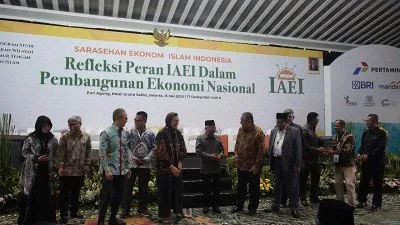

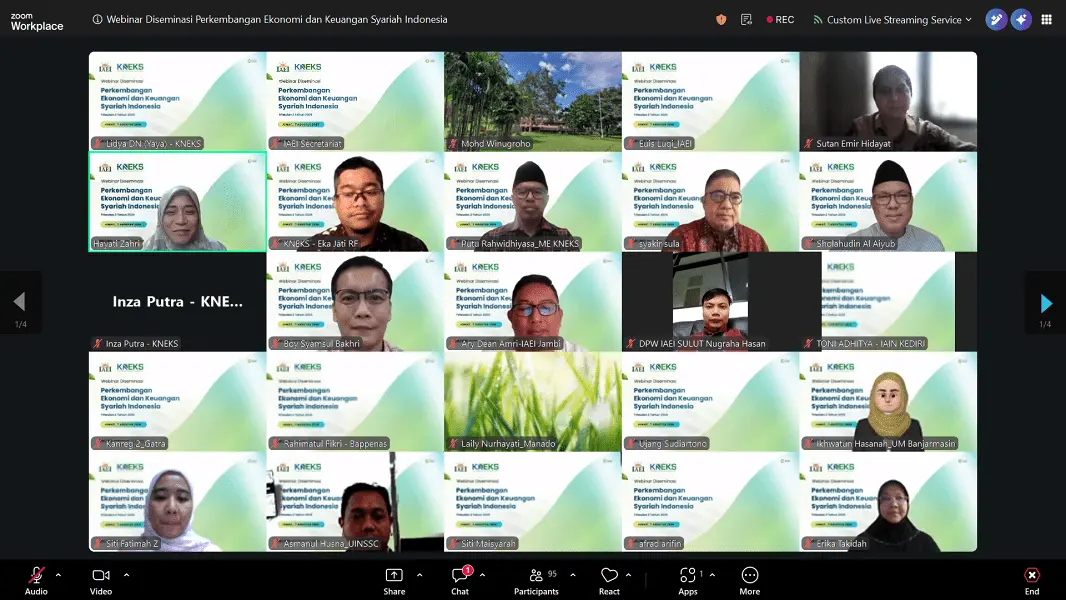
The Central Executive Board of the Indonesian Association of Islamic Economists (IAEI), together with the National Committee on Sharia Economics and Finance (KNEKS), believes that Indonesia needs to accelerate the strengthening of sharia economic governance through the enactment of the legal framework for the Indonesian Sharia Economic Master Plan (MEKSI) and the development of the Sharia Gross Domestic Product (GDP) as an instrument to measure the contribution of the Islamic economy to the national economy.
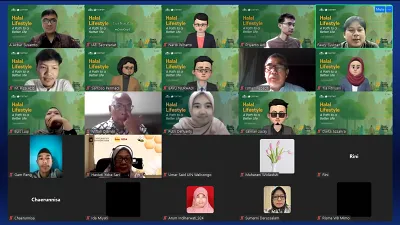
This call to action emerged during the Webinar on the Dissemination of Developments in Indonesia’s Islamic Economy and Finance for the Second Quarter of 2026, organized by IAEI in collaboration with KNEKS on Friday (August 7). The webinar presented the latest developments across various sectors of the Islamic economy as well as the challenges that still need to be addressed so that Indonesia can achieve its goal of becoming the global center of the Islamic economy by 2029.
IAEI Executive Chairman Muhammad Syakir Sula stated that Indonesia possesses immense potential to become a global leader in the Islamic economy, ranging from its Muslim population, academic capacity, to institutional support. However, this potential must be consolidated into a sustainable national movement.
“The Islamic economy should not be viewed merely as a business activity, but must become a collective movement—or ‘jihad iqtisadi’—to build the nation’s prosperity. IAEI is ready to strengthen collaboration among academics, regulators, industry players, and the public so that this potential truly becomes a national economic force,” said Syakir Sula.
KNEKS Executive Director Sholahudin Al Aiyub added that the government has incorporated the Islamic economy into the 2025–2045 National Medium-Term Development Plan (RPJPN), the National Medium-Term Development Plan (RPJMN), and the Asta Cita. Nevertheless, its implementation still requires instruments capable of unifying various ministries and agencies.
“The MEKSI needs a stronger legal foundation to serve as a common reference for all ministries and agencies. On the other hand, the development of Sharia GDP will provide a more accurate picture of the sharia economy’s contribution to national economic growth, ensuring that the policies adopted are increasingly targeted,” said Sholahudin.
The webinar revealed that the performance of Indonesia’s sharia economy and finance in the second quarter of 2026 continued to show positive growth. Total national Sharia financial assets reached Rp10,662 trillion, growing 6.4 percent year-over-year, while Sharia banking assets have surpassed Rp1,000 trillion with growth of around 11 percent. However, this growth rate remains below that of the national financial industry as a whole.
Globally, Indonesia currently ranks fourth in the Global Islamic Economy Indicator (SGIE). This ranking is considered not yet to reflect the full potential of Indonesia as the country with the world’s largest Muslim population. One of the reasons is the still-low contribution of the Islamic financial services sector, which carries significant weight in the index’s assessment.
In addition to the financial sector, the webinar also highlighted developments in the halal industry, Islamic social finance, and the strengthening of the Islamic economic ecosystem. Indonesia once again ranked second in the 2026 Global Muslim Travel Index (GMTI); the value of halal product exports increased to approximately US$63 billion, while the halal certification program continued to expand, with a total of about 4.2 million halal certificates covering 13.7 million products as of July 2026.
In the field of Sharia social finance, KNEKS is promoting the optimization of zakat and waqf collection as instruments of national development. The use of the National Socio-Economic Single Data System (DTSEN), the strengthening of the National Zakat Index, and the establishment of waqf-based financing institutions are expected to enhance the effectiveness of poverty alleviation while expanding the economic impact of Sharia finance on society.
The webinar featured speakers from IAEI and KNEKS, including Putu Rahwidiasa, Director of Sharia Entrepreneurship Business at KNEKS; Sultan Emir Hidayat, Director of Sharia Ecosystem Infrastructure at KNEKS, who also serves as Secretary General of the IAEI Central Executive Board, Sultan Emir Hidayat; Eka Jati Rahayu Firmansyah, Representative of the Director of Sharia Financial Services at KNEKS; and Bagus Aryo, representing the Director of Sharia Social Finance at KNEKS.
The speakers also noted that enhancing the competitiveness of the Sharia economy in the future requires cross-sectoral synergy through the strengthening of the halal industry, innovation in Sharia financial products, the acceleration of halal certification, the improvement of Sharia financial literacy and inclusion, and stronger regulatory support. These efforts are expected to accelerate the achievement of Indonesia’s goal of becoming a global center for the Sharia economy and finance, while also increasing the Sharia economy’s contribution to national economic growth.