
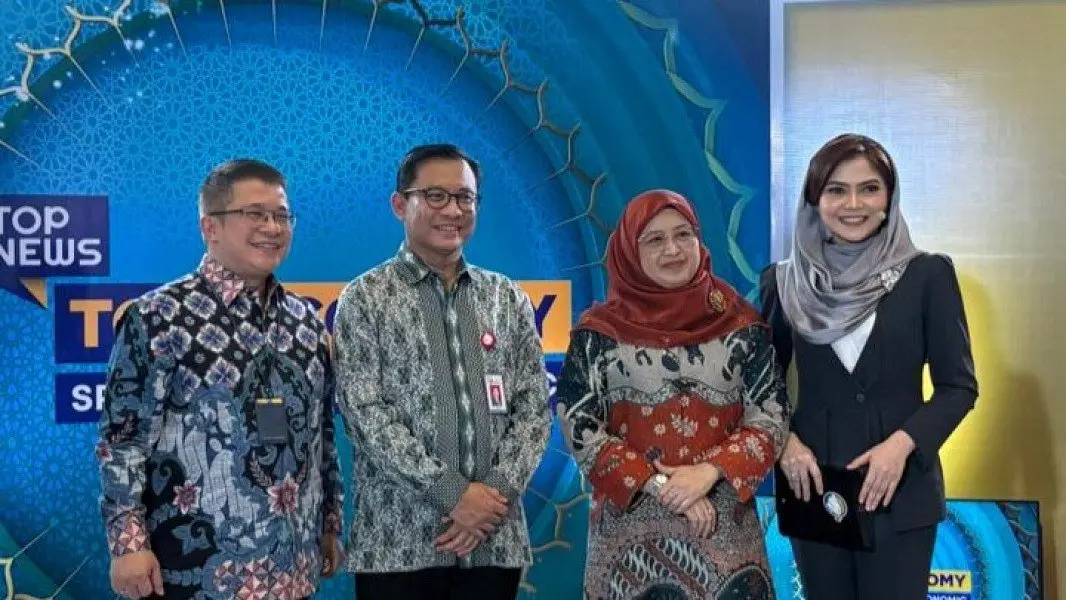
The Central Executive Board of the Indonesian Association of Islamic Economists (IAEI), in collaboration with Metro TV, hosted the talk show program “Top Economy Special: Islamic Economy,” which aired during Ramadan and focused on the overarching theme of strengthening Indonesia’s position as the global hub of the Islamic economy. The episode, which aired on Tuesday, March 17, 2026, at 9:05 PM WIB, underscored the importance of strengthening human resources (HR) and the Islamic economic ecosystem as key pillars in realizing Indonesia’s vision of becoming a world-class Islamic economic hub.
According to the 2025 State of the Global Islamic Economy report, Indonesia currently ranks third globally in the Islamic economy, underscoring its significant potential as a key player in the global Islamic economy. However, Indonesia still faces challenges regarding HR quality, financial literacy, and ecosystem integration, necessitating efforts to address these global challenges while enhancing national competitiveness.
Dr. Dadang Muliawan, Executive Director of the Department of Islamic Economics and Finance (DEKS) at Bank Indonesia, emphasized that Indonesia must be able to leverage the growth of the global Islamic economy as a new driver of economic growth.
“We must tap into new areas of economic development. Global consumption in the Islamic economy is projected to increase significantly, so Indonesia needs to strengthen a competitive production ecosystem for both domestic and export markets within the halal value chain,” he said.
Dr. Dadang also stressed the importance of policy integration within the National Medium-Term Development Plan (RPJMN) and the government’s Asta Cita, so that the Islamic economy not only boosts GDP growth but also strengthens economic inclusivity and equity.
From the regulatory perspective, Deden Firman Hendarsyah, Deputy Commissioner for Licensing and Quality Control at the OJK, highlighted the importance of ecosystem development as the key driver. Indonesia’s Islamic finance sector has grown by approximately 8.5% through early 2026, with total assets exceeding Rp3,000 trillion; however, further acceleration is needed to compete on a global scale.
“The development of the Islamic economy must be ecosystem-based. Currently, Islamic financial literacy has reached around 43%, but inclusion stands at only 13%. This means understanding is there, but access still needs to be expanded,” he explained.
The Head of the Human Resources, Islamic Economics, and Finance Development Division at IAEI, Prof. Dr. Amalia, M.Ag., noted that Indonesia holds an advantage in terms of human resources. “With 87% of the population being Muslim and the demographic dividend, this represents a significant strength. Combined with over 950 Islamic economics study programs, this constitutes a highly strategic investment in human resources,” she stated.
However, Prof. Euis Amalia emphasized that quality improvement remains essential, particularly in mastering digital economics and obtaining internationally recognized certifications. Indonesia needs human resources who are not only capable of production but also of innovation to create competitive halal products in the global market, including halal auditors with international standards.
Meanwhile, the Chair of the Strategic Communications and International Cooperation Division at IAEI, Prof. Dr. Murniati Mukhlisin, MAcc., CFP, noted that Indonesia excels in terms of its ecosystem and the number of talents. “With over 950 programs, Indonesia possesses a very large talent pool. This is complemented by a comprehensive hexahelix ecosystem involving academia, business, government, media, communities, and aggregators,” she explained.
Prof. Murniati added that Indonesia’s wealth of data, research, and Islamic economic practices constitutes a unique advantage in enhancing human resource quality.
Strengthening Indonesia’s Islamic economy requires close synergy between digitalization, financial inclusion, and integrated policies. Access to Islamic finance is driven through innovative digital services, accompanied by a physical presence to build trust. Strengthening the foundation is carried out through a comprehensive strategy, covering the development of the real sector, the financial system, financial literacy, and the integration of Islamic instruments for financing development, SMEs, and Islamic boarding schools. Improving literacy based on segmentation is crucial for inclusivity. Holistic and coordinated cross-sectoral policies are needed to accelerate progress. With global connectivity, innovation, productivity, and collaboration, Indonesia is optimistic about becoming a key player in global Islamic economic leadership to realize the Indonesia Emas 2045 Vision.