
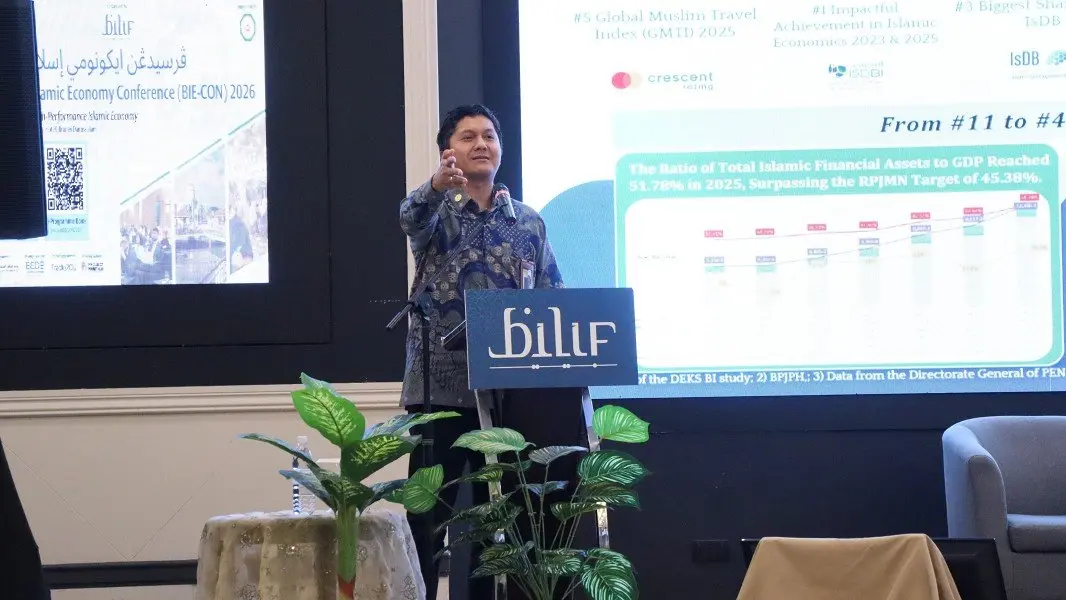
The Secretary General of the Indonesian Association of Islamic Economists (IAEI), Dr. Sutan Emir Hidayat, shared Indonesia’s experience in building an Islamic economic ecosystem at the Brunei Islamic Economy Conference (BIE-CON) 2026 in Bandar Seri Begawan, Brunei Darussalam, on Wednesday (June 24). The IAEI’s participation in this forum—which brought together policymakers, academics, industry players, and religious scholars from the ASEAN region and the Gulf Cooperation Council (GCC)—is part of efforts to strengthen international collaboration in the development of the Islamic economy.
In his keynote address titled “Indonesia’s Islamic Economy Blueprint: Building a Multi-Sector Halal Ecosystem – Lessons for a High-Performance Islamic Economy," Dr. Sutan Emir, who also serves as Director of Sharia Ecosystem Infrastructure at KNEKS, emphasized that Indonesia has experience to share with partner nations, while also opening opportunities for mutual learning in building a more inclusive and competitive Islamic economic ecosystem.
International collaboration is a key factor in accelerating the development of the Islamic economy. “We are opening our doors as wide as possible to collaboration with partner nations in the ASEAN and GCC regions, including Brunei Darussalam, to continue exchanging experiences and strengthening an inclusive Islamic economic ecosystem for the region as a whole,” said Dr. Sutan Emir.
In his presentation, Dr. Sutan Emir began by outlining the three main challenges Indonesia still faces: the gap in halal product exports, the need to increase the share of Islamic finance, and the gap between Islamic financial literacy and inclusion. According to him, acknowledging these challenges is the first step toward formulating more targeted and sustainable policies.
Building on these challenges, Dr. Sutan Emir explained the transformation Indonesia has achieved over the past seven years. Indonesia has successfully risen from 11th to 4th place globally in the Global Islamic Economy Indicator (GIEI), supported by the growth of the halal industry, the strengthening of the Islamic finance sector, the expansion of halal certification, and the establishment of Regional Committees for Islamic Economy and Finance (KDEKS) in various provinces to bolster policy implementation at the regional level.
According to him, these achievements are the result of building an integrated policy framework—ranging from strengthening the national legal foundation, drafting the Indonesian Sharia Economy and Finance Master Plan (MEKSI), coordinating across ministries and agencies through KNEKS, to developing the five pillars of the sharia economy that are interconnected within a single ecosystem.
On that occasion, Dr. Sutan Emir also shared five policy lessons that could serve as a reference for countries in the ASEAN and GCC regions. These lessons include the importance of strengthening the legal foundation for Islamic economic development; establishing a coordinating body with strong political support; utilizing mandatory policies to accelerate the growth of the halal industry; integrating social and commercial financing through Sharia-compliant instruments; and strengthening performance measurement systems down to the regional level.
For IAEI, international forums such as BIE-CON serve as a strategic platform to strengthen Indonesia’s intellectual diplomacy while expanding collaborative networks among Islamic economy stakeholders at the global level. Through such collaboration, it is hoped that various joint initiatives will emerge in the fields of research, human resource development, policy innovation, and the strengthening of the halal industry—all of which will benefit the region.
Collaboration between ASEAN and GCC countries is a strategic step toward building a more resilient, inclusive, and sustainable Islamic economic ecosystem. “IAEI is committed to continuing to promote the strengthening of international networks as part of our efforts to position Indonesia not only as a market for the Islamic economy but also as a source of ideas, innovations, and best practices that can contribute to the development of the global Islamic economy,” concluded Dr. Sutan Emir.