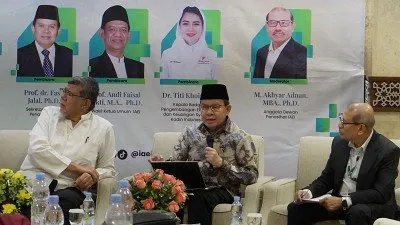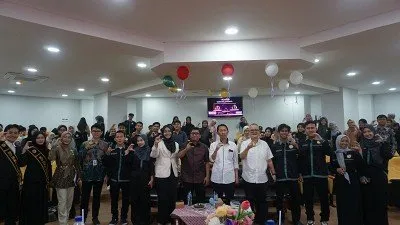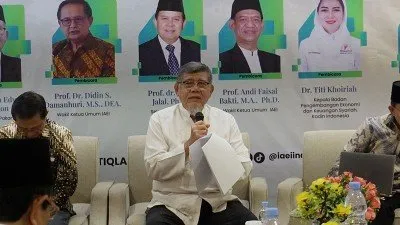

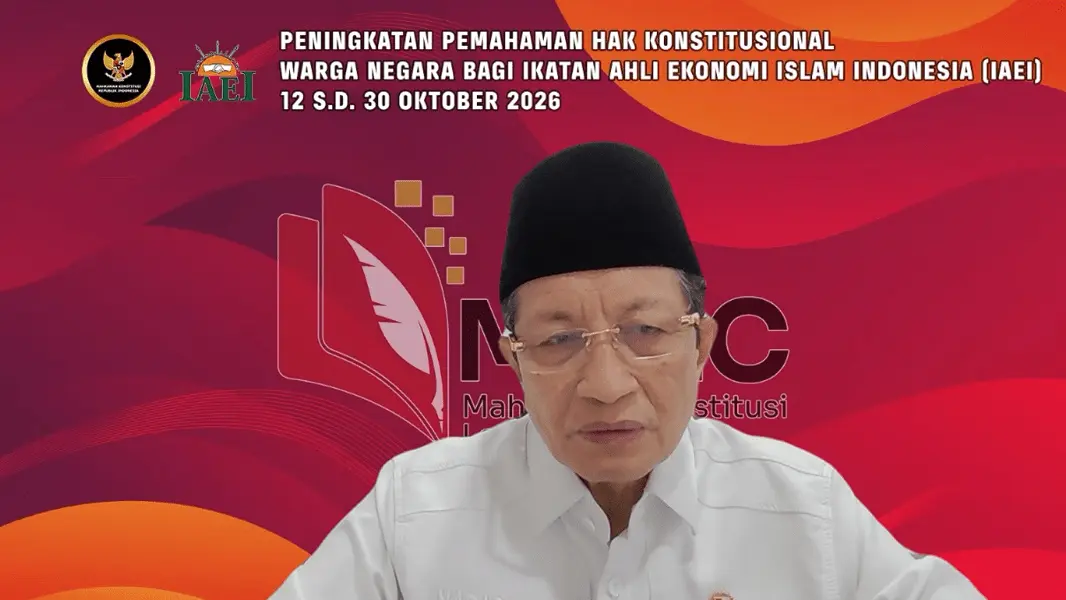
The Central Executive Board of the Indonesian Association of Islamic Economists (IAEI), through its Division of Islamic Economic Law Development, in collaboration with the Constitutional Court (MK) of the Republic of Indonesia, organized a technical training program on “Enhancing Understanding of Citizens’ Constitutional Rights (PPHKWN)” for IAEI executives and members. The event took place online from October 12 to 30, 2026, via the Constitutional Court Learning Center (MKLC) e-learning platform.
IAEI Chairman Prof. Nasaruddin Umar expressed his appreciation for the collaboration and the successful organization of this event. “We welcome this collaboration as a strategic step to strengthen constitutional understanding and enhance the capacity of human resources in the Islamic economics sector in Indonesia,” said Prof. Nasaruddin Umar at the event’s opening on Monday (October 12).
According to the Chairman, developing members’ competencies is a crucial part of the organization’s responsibilities. Islamic economists are expected not only to master Islamic economics and finance but also to possess a broad perspective on social, national, and state affairs.
Prof. Nasaruddin linked the understanding of constitutional rights to the maqashid al-sharia—the objectives of Islamic law—which include the protection of religion (hifz al-din), life (hifz al-nafs), intellect (hifz al-‘aql), lineage (hifz al-nasl), and property (hifz al-mal). According to him, the public interest is not only related to economic well-being but also to the protection of rights, the quality of knowledge, human dignity, and the sustainability of community life.
For Islamic economists, this knowledge is essential so that their contributions extend beyond the development of Sharia-compliant industries and financial instruments to include policy formulation and the strengthening of governance that upholds justice and the public interest.
“Serving the community requires more than just mastery of Islamic economics and finance; it also demands an awareness of one’s rights, obligations, and responsibilities as a citizen,” he emphasized.
The Chairman reaffirmed the role of the IAEI as an intellectual forum that brings together academics, practitioners, researchers, and the public. The IAEI must continue to foster dialogue, strengthen knowledge exchange, and build cross-sectoral collaborations—including with state institutions such as the Constitutional Court—so that scholarly ideas in Islamic economics do not remain confined to the academic realm but address societal needs and support the formulation of better policies.
“May the synergy we are building with the Constitutional Court through this training not only enhance the participants’ capacity but also become part of our scientific and national contributions toward building a more just Indonesia,” he concluded.