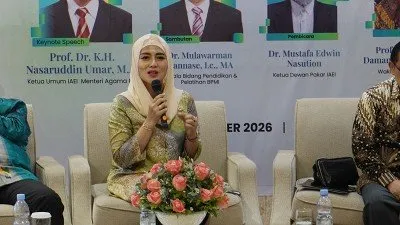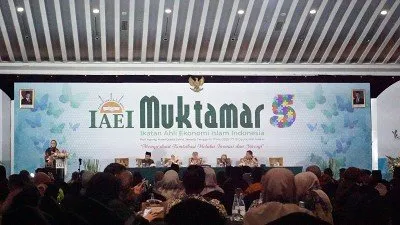

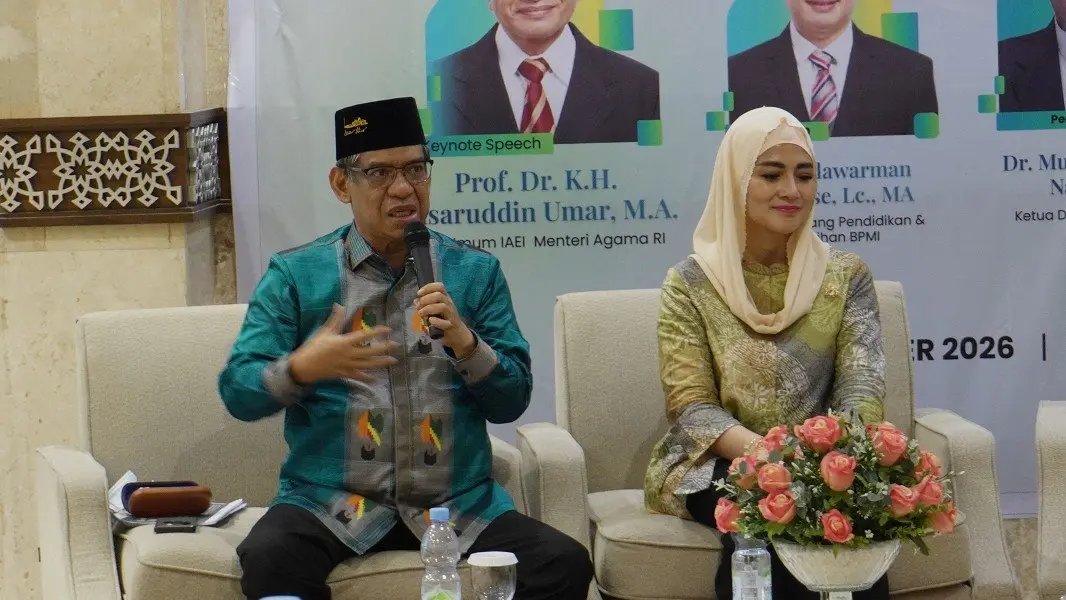
Islamic economic resilience needs to be built through an architecture that integrates commercial, social, moral, digital, and environmental strengths. This was conveyed by the Deputy Chairman of the Indonesian Islamic Economists Association (IAEI), Prof. Andi Faisal Bakti, at the National Mudzakarah and Discussion Forum of the IAEI Expert Council in the VVIP Hall of the Istiqlal Mosque in Jakarta, Tuesday (September 29).
Andi Faisal stated that Islamic economics needs to be positioned as an interconnected architecture, not simply a collection of instruments or sectors operating independently.
"We need to build an architecture of Islamic economic resilience. One instrument alone is not enough. Sharia banks, zakat, waqf, MSMEs, the digital economy, and the green economy must all be connected within a single ecosystem," said Andi Faisal.
He explained that this architecture has at least three layers that need to be built simultaneously. The first layer is commercial strength through sharia banking, sukuk, fintech, investment, and productive financing to support growth, production, investment, and job creation.
The second layer is social power through zakat, infaq, sedekah, and waqf, which can serve as a safety net when communities face economic pressures and serve as an instrument of empowerment. The third layer is morality and ethics, encompassing justice (mizan), trustworthiness, transparency, and ethical boundaries in economic activity.
According to him, the same principles need to be applied to the development of the halal industry. Sharia compliance does not stop at fulfilling formal requirements but needs to be translated into tangible economic and social benefits. The orientation of Islamic economic development also needs to be expanded from simply strengthening the domestic market to the ability to compete in global value chains.
To support this, Andi Faisal proposed the integration of five ecosystems: value chain, Islamic finance, social finance, digital economy, and green economy. These five ecosystems can provide different but complementary support for businesses.
He believes this integration is also crucial for Indonesia, which has a large Muslim population. He believes the Muslim population needs to be translated into productive power and added value creation, not just a consumption base.
This transformation requires strengthening production capacity, research and innovation, financing, human resources, standardization, and access to international markets. According to him, economic competitiveness needs to be measured by the ability to dominate the value chain and produce value-added products, not solely by market size.
Within this framework, Islamic economic development is not only directed at expanding the scale of the sharia industry, but also at building an ecosystem capable of creating added value and productivity, strengthening community empowerment, and enhancing the national economy's ability to withstand various global shocks.