
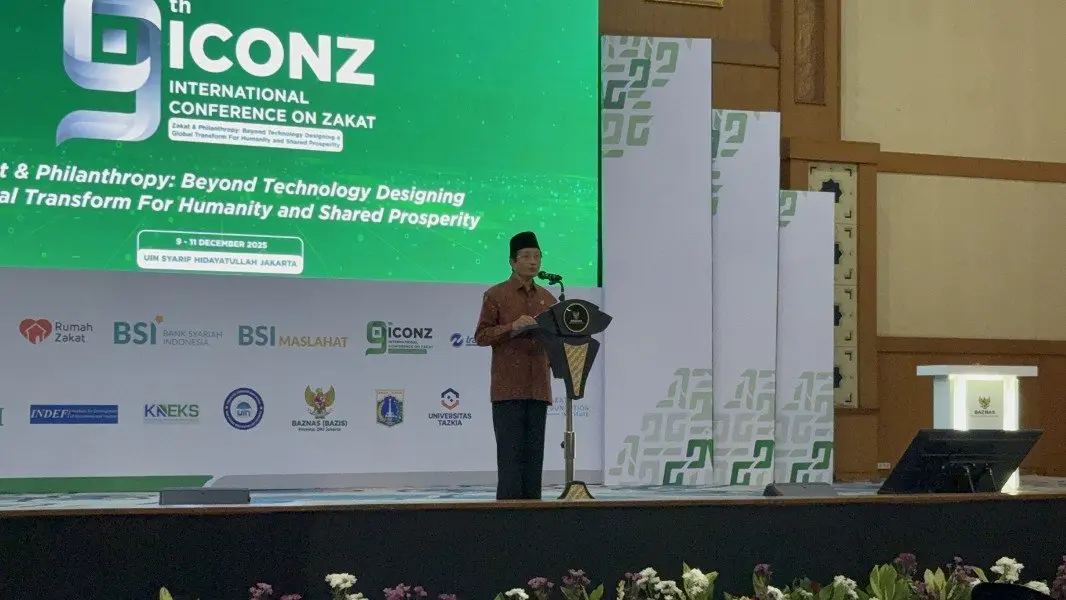
Indonesia reaffirmed its position as a global center for zakat development through the 9th International Conference on Zakat (ICONZ), which was officially opened by the Minister of Religious Affairs of the Republic of Indonesia and Chairman of the Indonesian Association of Islamic Economists (IAEI), Prof. Dr. Nasaruddin Umar, MA., at the Auditorium of UIN Syarif Hidayatullah Jakarta, Wednesday (12/10). Carrying the theme "Zakat & Philanthropy: Beyond Technology – Designing a Global Transform for Humanity and Shared Prosperity," the 9th ICONZ served as a strategic forum for formulating a new direction for global zakat governance.
In his speech, the Chairman emphasized that zakat is the moral and spiritual foundation for the development of the ummah. He emphasized that zakat cannot be separated from the entire sharia economic ecosystem. Strengthening zakat will be more optimal if it is placed within a more integrated national Islamic economic framework, ranging from fiscal policy, Islamic financial inclusion, MSME empowerment, to the digitalization of public services.
"We need a practical roadmap that can guide policymakers and implementers to maximize real impact on society," he said.
He also emphasized three main points: the importance of integrating zakat into national development policies as an instrument for poverty alleviation; the need for connectivity between digital innovation, artificial intelligence, and data governance for more accurate and targeted zakat management; and the use of zakat diplomacy as Indonesia's soft power to strengthen the country's position as a global standard-setter for zakat governance. These three ideas emphasize that developing global zakat requires synergy between science, policy, and cross-institutional collaboration.
The Chairman of BAZNAS, Prof. Dr. KH Noor Achmad, MA., stated that this conference represents BAZNAS' commitment to making zakat a global force in responding to poverty and expanding social protection.
The 9th ICONZ is not only a scientific conference but also a strategic opportunity for Indonesia to strengthen its position as a global zakat reference center. The collaboration between BAZNAS, UIN Jakarta, the Ministry of Religious Affairs, IAEI, KNEKS, BSI, and various national and international partners demonstrates that Indonesia's zakat ecosystem has entered a new phase: more standardized, more digital, more global, and more integrated into national development.