
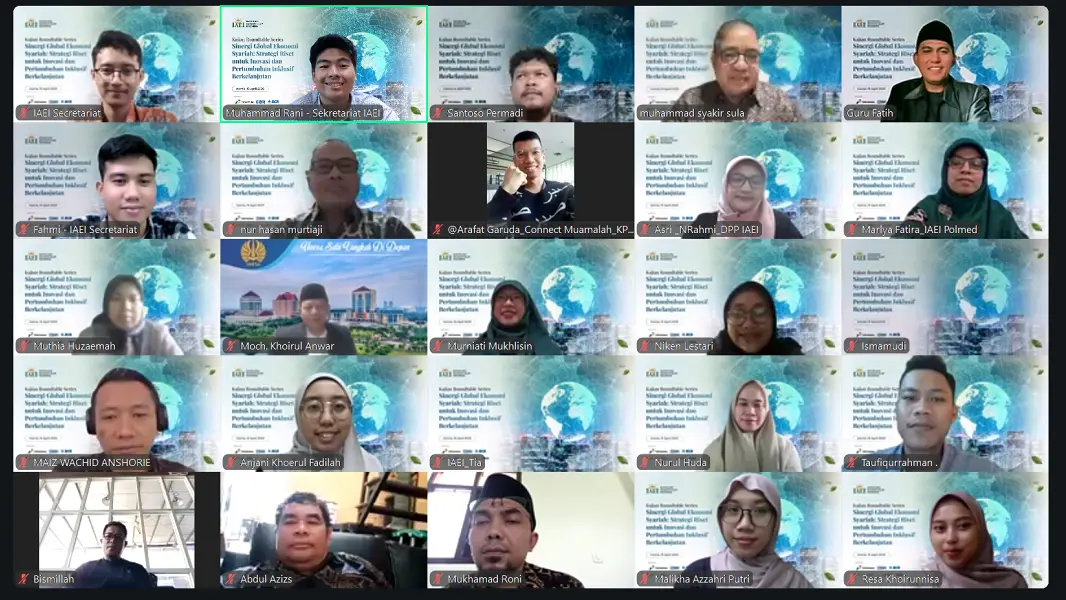
In an effort to strengthen Indonesia's position on the global Islamic economic map, the Indonesian Association of Islamic Economists (IAEI) held a Roundtable Series study entitled "Global Synergy of Islamic Economics: Research Strategies for Innovation and Sustainable Inclusive Growth." The event was held virtually on Thursday, April 16, 2026, via Zoom Meeting and brought together academics, practitioners, and policymakers from various backgrounds.
IAEI's Daily Chair, Muhammad Syakir Sula, opened the event and emphasized the importance of closer collaboration between academics and industry practitioners in driving the progress of the Islamic economy in Indonesia. He stated that the various challenges still faced, particularly in the Islamic insurance and banking sectors, require strong research support to translate into implementable solutions.
"Strengthening the role of research is key to bridging the gap between conceptual development and practical needs in the field, so that the Islamic economy can grow more optimally and sustainably," said Syakir Sula.
Meanwhile, Murniati Mukhlisin, Head of Strategic Communication and International Cooperation at the Indonesian Association of Islamic Scholars (IAEI) and Professor at Tazkia University, emphasized the importance of global standardization in Islamic economics and finance to increase competitiveness and strengthen cross-border integration. She also highlighted the urgency of developing a more focused global research agenda, particularly on the development of the digital Islamic economy and social finance. "Islamic economics has now evolved into a mainstream lifestyle for Muslim communities, as reflected in the increasing availability of halal products and the development of Islamic-based educational institutions," she explained.
On the same occasion, Nur Hasan Murtiaji, Chair of the IAEI Strategic Communication Committee, highlighted several challenges in the development of Islamic finance, such as the suboptimal integration of social and environmental aspects, regulatory gaps, and limited research-based innovation. However, he sees significant opportunities in the growth of the global Muslim population and the acceleration of economic digitalization. He emphasized the importance of systematic global campaigns and the utilization of digital, social, and community media platforms to strengthen literacy and broader adoption of Islamic economics.
Hurriyah El Islamy, from the IAEI Strategic Communications Committee and Founding CEO of HGC Firm, emphasized the importance of international research collaboration in driving innovation in the Islamic economy. She outlined several collaboration models, such as research consortiums, hub-and-spoke, co-creation, and digital platforms, as strategic approaches to building cross-border partnerships. She argued that global collaboration needs to be based on the principles of fairness, institutional interoperability, and sustainability to generate broader impact.
Furthermore, Asri Noer Rahmi from the IAEI International Cooperation Committee and a lecturer at Al Azhar University Indonesia emphasized the importance of research-based innovation through synergy between researchers, industry, government, and academia. He highlighted the need for more effective research downstreaming mechanisms so that research results can be implemented effectively and provide added value to the development of the Islamic economy.
This forum serves as a strategic space to encourage more targeted international collaboration, particularly in strengthening research as the primary foundation for innovation and development in the Islamic economy industry. Amid increasingly complex global dynamics, the integration of research, policy, and industry practice is considered increasingly crucial for producing solutions with real and sustainable impact.