
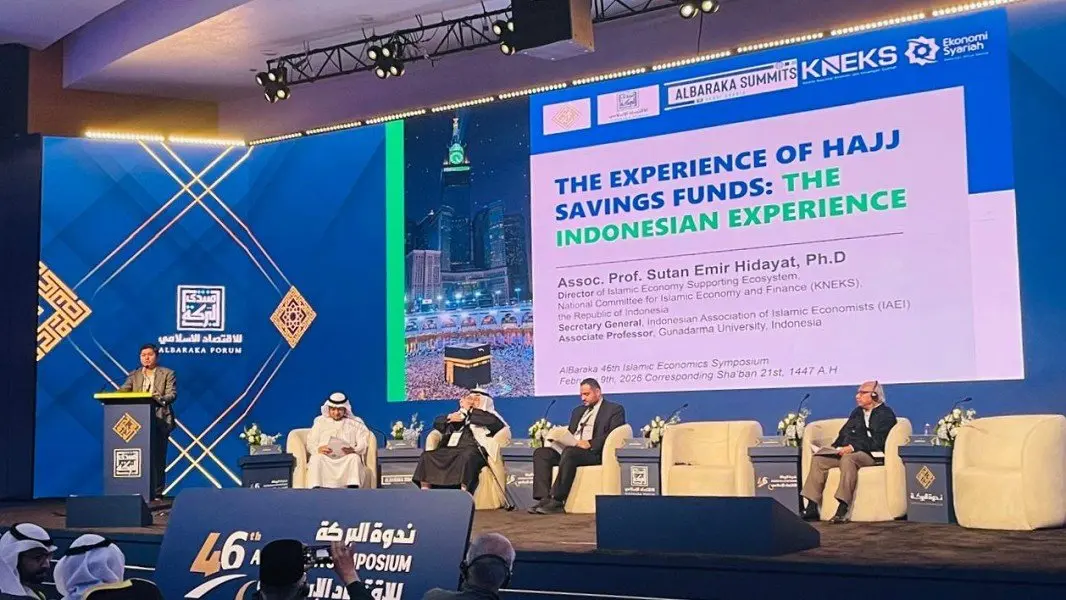
Secretary General of the Association of Islamic Economists (IAEI) and Director of the Sharia Economic Ecosystem Infrastructure at KNEKS, Dr. Sutan Emir Hidayat, was a speaker at the international forum Al -Baraka Symposium for Islamic Economics in a session themed Charity and Investment Channels: Charitable Investment within the Framework of Shari'a Discipline held at Prince Mugrin University, Madinah, which took place on February 9-11, 2026. This involvement is part of IAEI's ongoing efforts to bring Indonesia's experiences and ideas to the global discussion on Islamic economics.
At the forum, which brought together Islamic economists, practitioners, and thinkers from various countries, Dr. Sutan Emir reviewed the transformation of Indonesia's hajj fund management, particularly since the establishment of the Hajj Fund Management Agency (BPKH), which changed the old travel agency-based model to a professional investment management system that is fully compliant with sharia principles.
This transformation was the result of institutional reform, strengthened governance, and a paradigm shift that viewed hajj funds not merely as deposits, but as a trust that must be managed productively without neglecting prudence. Data for the 2019–2025 period shows that the funds managed by BPKH have reached around IDR 173.9 trillion as of September 2025, with relatively stable investment returns in the range of 6-7 percent per year. This figure is an indicator that the management of public funds can be carried out safely while providing real added value.
One innovation that attracted the attention of symposium participants was the discussion on Cash Waqf Linked Sukuk (CWLS). This model combines social financial instruments such as waqf with commercial instruments in the form of state sukuk, thereby opening up space for the integration of social finance and public finance within a mutually reinforcing framework. Through this approach, funds are not only managed to maintain the sustainability of Hajj costs, but also contribute to the financing of infrastructure projects and broader development programs. International recognition of this innovation can be seen from the IsDB Prize for Impactful Achievement in Islamic Economics in 2023.
The management of Hajj funds is not merely an administrative matter, but a great responsibility that must be managed professionally, transparently, and productively for the benefit of the people. “Indonesia continues to innovate to ensure that Hajj funds are not only stored safely, but also grow and provide optimal benefits for Hajj pilgrims and national sharia economic development,” said Dr. Sutan Emir Hidayat.
The paper presented five strategic recommendations for the future development of Indonesia's Hajj fund management. First, diversify the portfolio by increasing allocations to sharia-compliant equity and infrastructure investments. Second, integrate waqf through the development of the Hajj Waqf program to provide subsidies for low-income pilgrims. Third, improve operational efficiency to reduce the Cost of Hajj Pilgrimage (BPIH). Fourth, expand the acceleration program to speed up departure through non-regular hajj routes. Fifth, increase digital transparency to facilitate access to information on investment returns and waiting list status.
IAEI's involvement in this international forum reflects a strategic step to continue strengthening Indonesia's position as one of the world's centers of Islamic economics. In recent years, Indonesia has shown significant progress. Based on the Global Islamic Economy Indicator (SGIE) Report 2024/2025, Indonesia ranks third in the world, up from 11th in 2018. Indonesia is also listed as the third-largest shareholder in the Islamic Development Bank (IsDB) and has achieved various important milestones in the Islamic economy sector, including second place in Islamic Finance, first place in Modest Fashion, and fifth place in the Global Muslim Travel Index 2025.
This participation is also in line with the national commitment to strengthen the Islamic economic and financial ecosystem as outlined in the Asta Cita of President and Vice President Prabowo-Gibran, the 2025-2026 National Medium-Term Development Plan (RPJMN), and the 2025-2029 Indonesian Islamic Economic and Financial Masterplan (MEKSI). In this context, IAEI's presence at the Al-Baraka Symposium not only represents the academic community but also forms part of Indonesia's collective efforts to build a stronger, more inclusive, and globally competitive Islamic economic foundation.