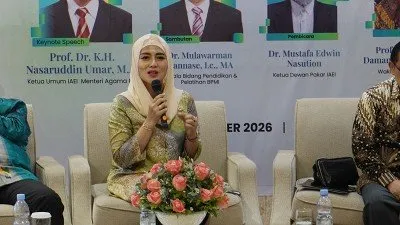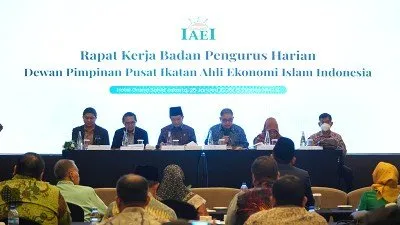

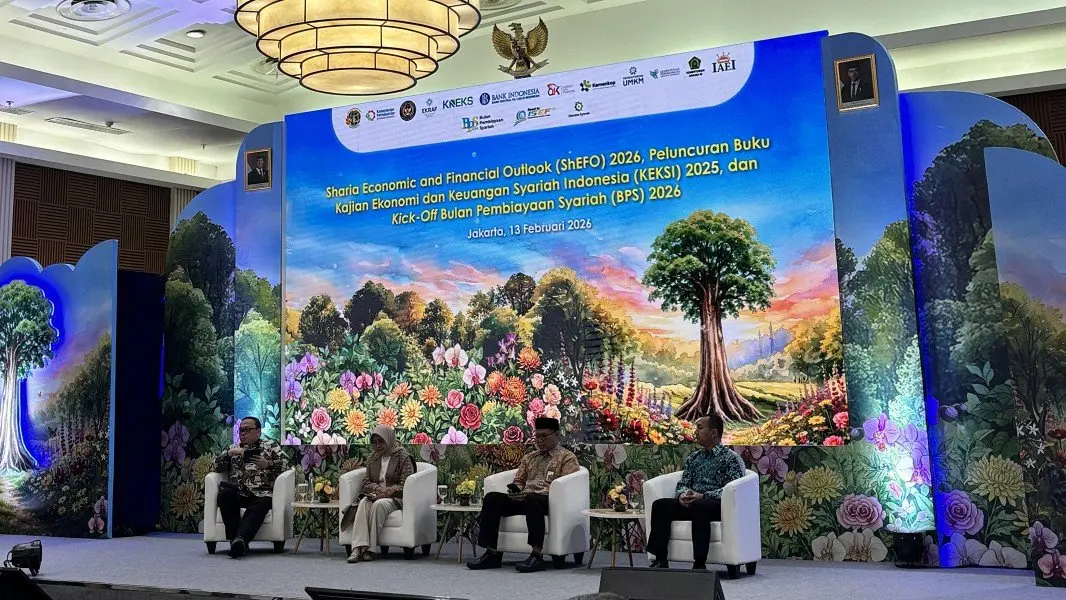
Synergy between the Indonesian Association of Islamic Economists (IAEI), Bank Indonesia, and various sharia economic stakeholders was further strengthened through the holding of the Sharia Economic and Financial Outlook (SHEFO) 2026, the launch of the 2025 Indonesian Sharia Economic and Financial Study (KEKSI) Book, and the kick-off of Sharia Financing Month 2026. Also in attendance was IAEI Deputy Chairman Prof. Dr. Irfan Syauqi Beik, SP, MSc. Ec., who also served as moderator for this forum. This forum served as a strategic consolidation space to ensure that the Sharia economy and finance are increasingly integrated into the national development agenda.
Amid Indonesia's economic growth of around 5.11 percent, the Halal Value Chain sector recorded even higher growth of 6.2 percent. This achievement shows that the halal ecosystem has strong momentum and is increasingly relevant as a new source of growth. In a dynamic global environment full of pressure, strengthening this sector is considered necessary to be done collaboratively and purposefully.
In a national talk show session hosted by Prof. Irfan Syauqi Beik, it was emphasized that the Islamic economy has vast room for growth if all its potential is mobilized together. “The Islamic economy is a new potential source, and amid the current global dynamics, we need to develop all existing potential,” he said. This statement underscores the importance of synergy between sectors, from regulators, business actors, academics, to professional associations.
The Executive Director of the National Committee for Sharia Economics and Finance (KNEKS), Sholahudin Al-Aiyub, also highlighted the momentum of what is considered a historic policy. “The Islamic economy has only now been included in the RPJMN and has become a national priority. Previously, there was no national planning for the Islamic economy,” he said. The inclusion of the Islamic economy in the RPJMN reinforces its position as part of national development planning, in line with the implementation of Asta Cita, which is expected to build an inclusive and sustainable Islamic economy.
From the halal industry perspective, Anom Wiyarto, Halal Supervisor at PT Amerta Indah Otsuka Factory Kejayan, emphasized the importance of viewing opportunities objectively amid various public perceptions. “There are indeed many negative stigmas now, but we must look at it from the potential of the halal industry because Indonesia has a Muslim majority of more than 87% and certainly needs halal products,” he said. This statement reminds us that the strength of the domestic market is a strategic foundation for the development of the national halal value chain.
The issue of digitalization is also a major concern. Hendri Saparini, founder of the Center of Reform on Economics (CORE) Indonesia, emphasized that technology has a significant role in strengthening competitiveness. "How big is the impact of digital technology on the economy? It will certainly have a big impact, but technology is an enabler for innovation. Technology will help with competitiveness, and one example is certification and efficiency in raw material production," he explained. Technology optimization is considered one of the keys to accelerating the transformation of the halal ecosystem.
The collaboration established in this forum shows that the development of the Islamic economy cannot rely on one institution alone. Solid coordination between authorities, industry, and academic networks is needed so that the broad direction outlined in the blueprint can be translated into real impact through a collective call to action: Let's work together to advance Eksyar.