
The government continues to strengthen the development of the sharia economy as part of its strategy to achieve inclusive and socially just economic development. This strengthening is being carried out through the expansion of sharia financial inclusion, increased access to financing, the development of the halal industry, and the optimization of the potential of Islamic social finance.
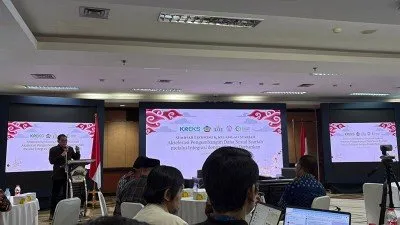
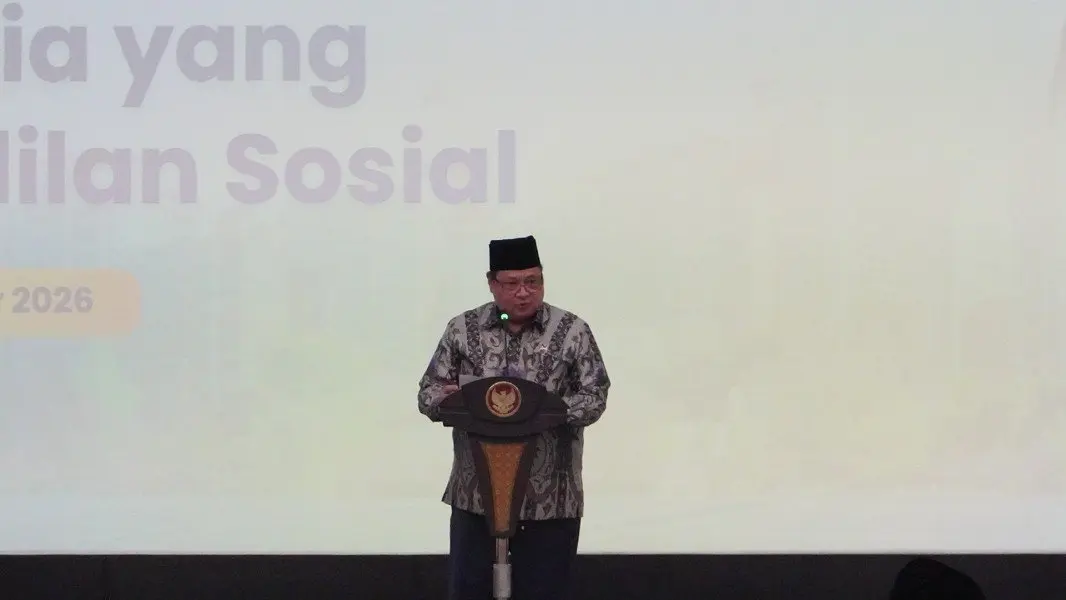
Coordinating Minister for Economic Affairs and Vice Chair of the Advisory Board of the Indonesian Association of Islamic Economists (IAEI), Airlangga Hartarto, stated that the principle of justice must serve as the foundation for ensuring that economic growth benefits all segments of society. Airlangga made these remarks at the Symposium on the Contributions of Pancasila Economics, Islamic Economics, and Conventional Economics: Toward Socially Just Development in Indonesia, organized by the IAEI in Jakarta on Tuesday (September 8).
“We are gathered here at this symposium on the contributions of Pancasila economics, Islamic economics, and conventional economics toward socially just development in Indonesia. If we look at justice—which is a core principle, as stated in Surah An-Nahl, verse 90: ‘Indeed, Allah commands you to be just and to do good’—this guides our economic policy: development must provide equitable benefits to the entire society, not just specific groups,” said Airlangga.
According to Airlangga, the development of the Islamic economy should not rely solely on the commercial financial sector. The potential of zakat, infaq, sadaqah, and waqf (ZISWAF) also needs to be optimized as part of social economic and financial instruments that can provide broader benefits to society.
Optimizing ZISWAF requires strengthening coordination and consolidation among institutions so that existing potential can be managed more effectively and have a greater impact on development and the improvement of public welfare.
In addition to the financial sector, the government continues to promote the strengthening of the halal industry through the expansion of halal certification and capacity building for MSMEs. Strengthening human resources, governance, and synergy between MSMEs and the Islamic finance industry are considered crucial components in building an increasingly competitive halal ecosystem.
Regarding the development of the Islamic economic ecosystem at the regional level, Airlangga cited the province of Aceh as a model worth emulating. The Islamic financial ecosystem in Aceh demonstrates synergy between the banking sector, non-bank financial institutions, and social finance through Baitul Mal.
This experience shows that the development of the Islamic economy requires integration among the financial sector, the real sector, and social finance so that its benefits can be felt more widely by the public.
Given its potential—ranging from Islamic financial assets and financing, the halal industry, to Islamic social finance—the Islamic economy has an increasingly significant role to play in contributing to the national economy. Strengthening this ecosystem is also expected to expand economic access for the public and enhance the role of MSMEs in development.
In this context, Airlangga noted that the IAEI plays a strategic role in strengthening collaboration and connecting various stakeholders in the Islamic economy.
“It is certainly our hope that the IAEI can become a driving force for Islamic economic collaboration in Indonesia’s development by connecting ideas, policies, and the Islamic economic ecosystem. I certainly hope that this symposium will generate constructive ideas and recommendations for Indonesia’s development policies that are inclusive and promote social justice,” concluded Airlangga.