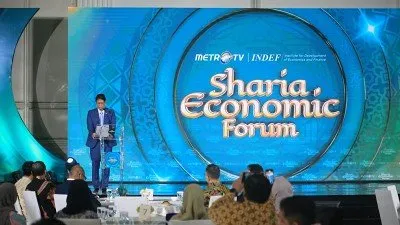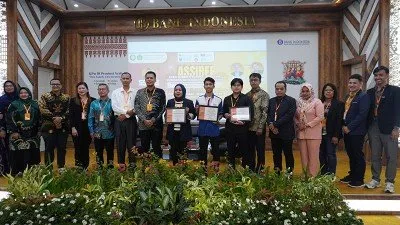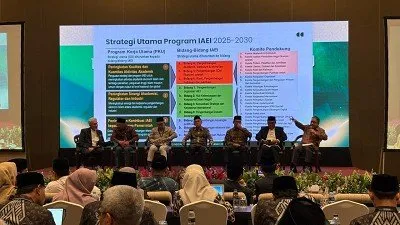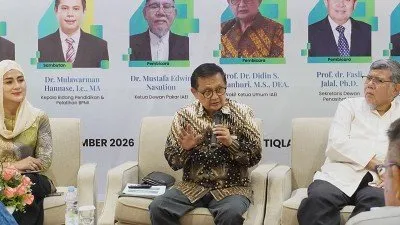

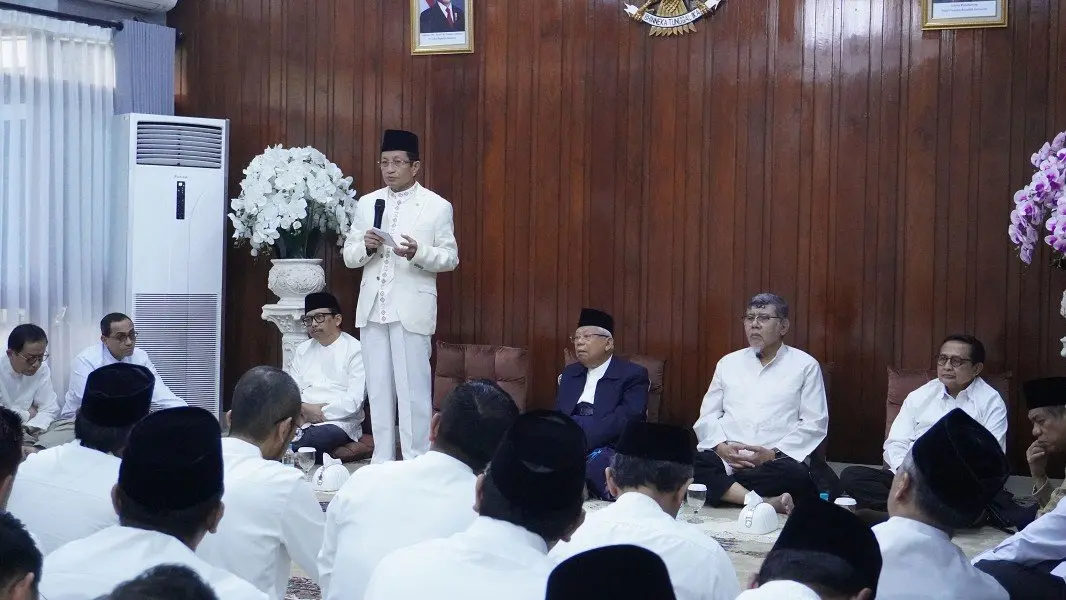
Chairman of the Indonesian Association of Islamic Economists (IAEI) Prof. Dr. Nasaruddin Umar, M.A. emphasized that Islamic economics has a strategic position in the direction of national development and can be an important pillar in realizing equitable and sustainable growth, which is in line with President Prabowo Subianto's vision of emphasizing economic independence. This statement was delivered at the “IAEI Joint Fast-breaking: 22nd Anniversary Celebration and Islamic Economy Stakeholders Gathering” held at the Minister of Religious Affairs' Official Residence in Jakarta on Sunday, March 1, 2026.
This moment was not only an agenda for breaking the fast together, but also a space for reflection on IAEI's 22-year journey in synergizing and collaborating on the development of the Islamic economy in Indonesia. In his speech, Prof. Nasaruddin Umar, who is also the Indonesian Minister of Religious Affairs, said that IAEI must strengthen its contribution of ideas amid the direction of national development. “As chairperson, we must strengthen our position, especially since President Prabowo's vision is very Islamic, so we have great potential to contribute our ideas,” he said.
Prof. Nasaruddin Umar believes that strengthening the Islamic economy requires a more serious study of Islamic references. “What we must do now is enrich our Islamic knowledge of economics, because we are too conceptual without reference to the hadith and classical Islamic texts.”
He also invited academics and practitioners to revisit the history of the Prophet's economy. “Then we must also look at how the Prophet Muhammad was able to change the trading traditions in Mecca.” According to him, economic diversification has been exemplified since the time of the Prophet. “Economic diversification, so it was the Prophet who created 27 coffers.” He emphasized the importance of bridging classical knowledge with a modern approach," he explained.
The agenda continued with a sermon delivered by the Chairman of the IAEI Advisory Council, Prof. Dr. (HC) KH. Ma'ruf Amin. In his presentation, he reminded the audience that economic activities have a spiritual dimension. “Actually, there are many forms of worship, and trading is also a form of worship,” he said.
The 13th Vice President of the Republic of Indonesia also emphasized the importance of synergy between scholars and economic actors in developing an applicable system. “Scholars only provide and determine whether something is in accordance with sharia principles, not in accordance with sharia principles, or can be corrected to be in accordance with sharia. But those who translate it into products are thinkers and economic activists, so collaboration is indeed necessary.”
According to him, the development of the sharia economy is directly related to efforts to revive fiqh muamalah in social life. “Why must it be a sharia economy? Because we must revive fiqh muamalah, so that it is not only taught in Islamic boarding schools and universities, but also practiced in our society,” he said.
KH. Ma'ruf Amin explained the direction of Islamic economic development in two major phases. “The socialization of Islamic economics has been taking place from 2000 to 2025, and the focus on making the economy Islamic will be from 2025 to 2050 with the target of increasing its market share. All of this can be achieved as long as we work together.”
The event was also attended by a number of national strategic figures, including the Indonesian Minister of Cooperatives, the Head of the Financial Services Authority, the Indonesian Deputy Minister of Finance, and the Chairman of the Indonesian National Zakat Agency (Baznas).
The agenda of the joint iftar became a forum for regulators, scholars, and practitioners to gather in one assembly. The conversations that flowed throughout the event showed an awareness that strengthening the sharia economy requires collective work and long-term commitment from all stakeholders.