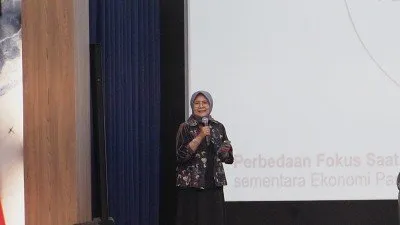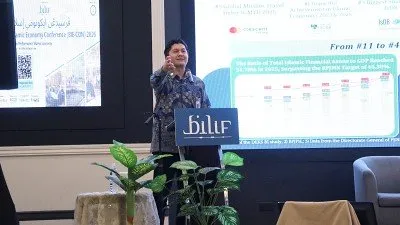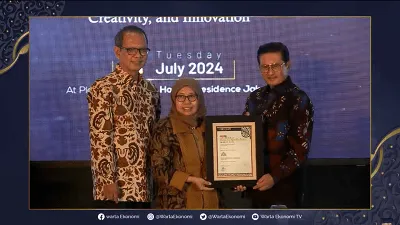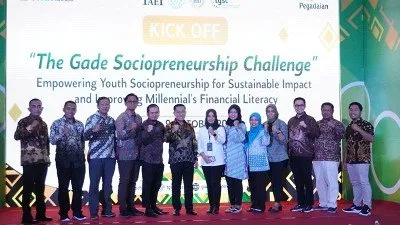

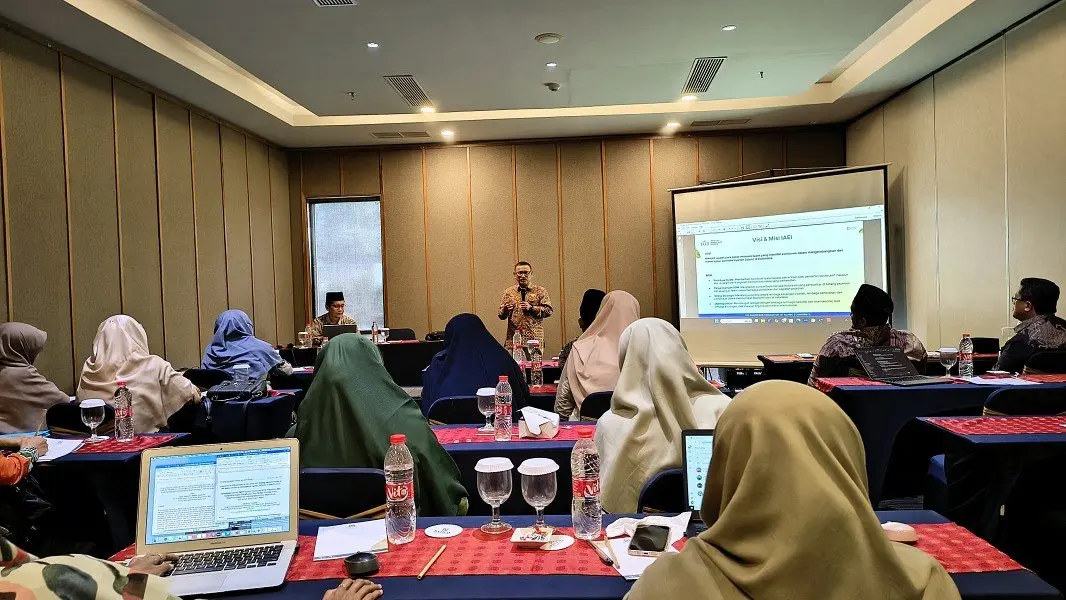
The Central Executive Board (DPP) of the Indonesian Association of Islamic Economists (IAEI) emphasized the importance of organizational strengthening, program synchronization, and the expansion of collaborative networks as the main agenda for IAEI’s regional development. This statement was delivered by the Head of the DPP IAEI’s Division of Organizational Development, Regional Guidance, and Branch Offices, Prof. Dr. A. Jajang W. Mahri, during the Working Meeting (Raker) of the IAEI Riau Provincial Executive Board (DPW) held in the Meeting Room of the Batiqa Hotel in Pekanbaru on Saturday, June 27.
According to Prof. Jajang, organizational strengthening must serve as the foundation for enhancing IAEI’s contribution to the development of the Islamic economy and finance. Therefore, every program implemented at the regional level must be aligned with the organization’s national policy direction to generate more tangible impacts for the community.
“Future IAEI programs must be realistic, measurable, and have a direct impact on the development of the Islamic economy and finance in the community,” said Prof. Jajang.
He explained that synchronization between the programs of the Central Executive Board (DPP), Regional Executive Boards (DPW), and local chapters is key to building an organization that is increasingly solid and responsive to the needs of Islamic economic development in various regions. In addition, strengthening collaboration with ministries and agencies, universities, industry, Islamic boarding schools, practitioners, and various other stakeholders must also be continuously expanded so that the role of IAEI is increasingly felt.
In his guidance, Prof. Jajang emphasized that there is still significant scope for service that IAEI can optimize at the regional level. Various aspects that are often viewed as simple actually hold strategic value in strengthening the implementation of the Islamic economy—ranging from improving halal slaughterhouses and the management of the halal food supply chain to various community economic activities that must always be oriented toward the principles of public welfare and Sharia compliance.
“Things that seem simple in the regions are actually major challenges for all of us. We must ensure that halal slaughterhouses, food supply chain management, and various community economic activities operate in accordance with the principles of public welfare and Sharia compliance,” he added.
In the area of organizational development, Prof. Jajang also encouraged the Riau Provincial Chapter of IAEI to strengthen its guidance of inactive chapters while simultaneously establishing new chapters at various universities and institutions with significant potential. According to him, expanding the organization’s base must be accompanied by ongoing consolidation and mentoring efforts so that IAEI becomes increasingly robust as a professional organization grounded in scholarship and service.
The working meeting was also attended by the Chair of the Riau Province IAEI Regional Executive Board, Boy Syamsul Bakhri, along with the board members. On this occasion, the Riau Province IAEI Regional Executive Board presented the progress of various programs that have been implemented, including scientific activities, discussion forums, research enhancement, and community service as part of the implementation of the Tri Dharma of Higher Education in the development of Islamic economics.
Through this working meeting, the IAEI Central Executive Board (DPP) hopes that all programs at the regional level will be more aligned with the national organization’s policy direction, while also strengthening the IAEI’s role as a strategic partner in the development of the Islamic economy and finance in Indonesia through organizational strengthening, collaboration, and tangible contributions at the regional level.