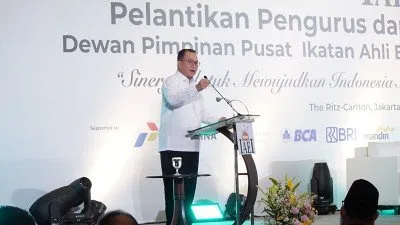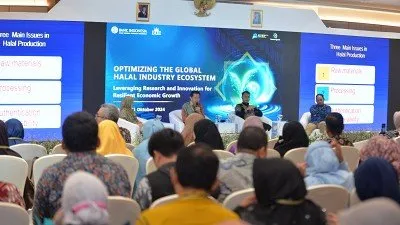

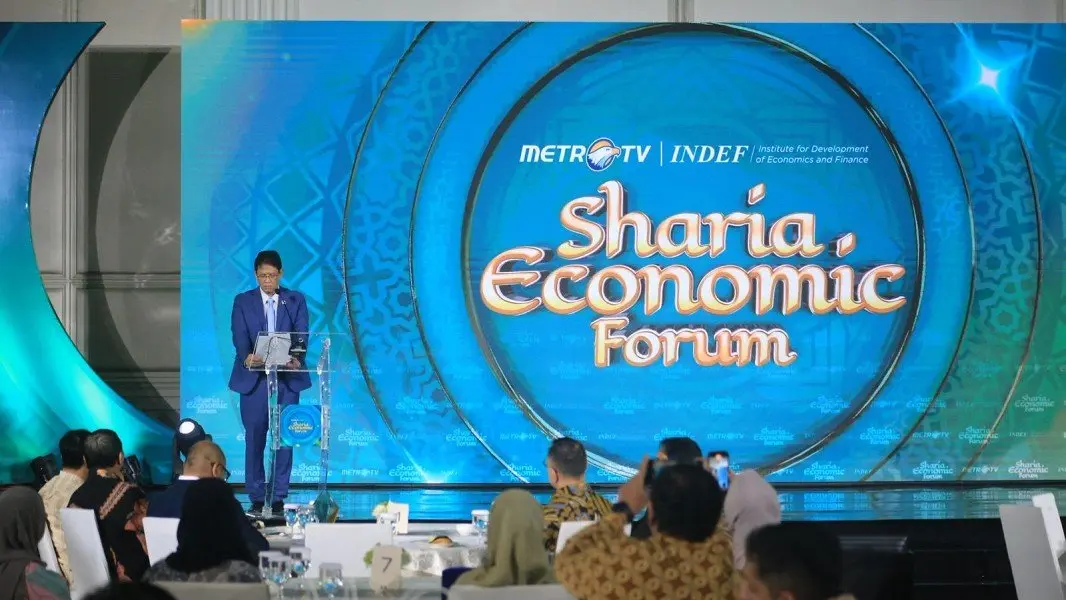
The Sharia Economic Forum 2026, held by Metro TV at The Tribrata Darmawangsa, Jakarta, on February 12, 2026, was an important forum for reading the direction of Indonesia's sharia economic policy going forward. In the forum entitled “Accelerating Growth and Prosperity: Path to Global Impact,” the Indonesian Minister of Finance and Deputy Chairman of IAEI, Mr. Purbaya Yudhi Sadewa, Ph.D., shared his firm, reflective, and strategic views on the position of the sharia economy in the national economic transformation.
At the beginning of his presentation, Mr. Purbaya acknowledged that in practice, the direction of Islamic economic policy is often not clearly visible in the public sphere. “There is no clear policy for Islamic economics; it is not very visible,” he said. He also recalled his experience in the bureaucracy when the narrative of Islamic economics did not always receive adequate space in policy forums. This statement reflects the fact that there has been a gap between the enormous potential and structured policy orchestration.
However, in the same forum, the Deputy Chairman emphasized that the Islamic economy is now part of Indonesia's grand economic transformation strategy. The government views the Islamic economy as a concrete instrument to strengthen fiscal resilience and promote equitable growth. The integration of the Islamic economy into fiscal policy is no longer just sectoral discourse, but is part of the long-term development framework.
Mr. Purbaya emphasized that the development of the Islamic economy should not stop at the level of nomenclature. The application of Islamic principles must be evident in financing practices, equitable economic distribution, and support for MSMEs and the productive sector. He reminded that the use of the Islamic label without strengthening governance, transparency, and the principle of fairness will not strengthen the foundations of the national economic system.
In the fiscal context, the government has made sharia instruments part of state financing. National sharia financial assets show a consistent growth trend. State sukuk has become one of the most trusted instruments for financing the state budget by global investors. This shows that the international market sees stability and credibility in financial instruments based on sharia principles.
He also emphasized that the development of the sharia economy requires strong synergy and orchestration between the government, academics, industry players, and professional communities such as IAEI. A sectoral approach is considered insufficient to fulfill Indonesia's ambition to become a global leader in this sector. Coordination across ministries, regulators, financial institutions, and educational institutions is needed so that policies, talent, and industry move in the same direction.
As part of the national strategic vision, the government has set a target in the 2025-2029 RPJMN to increase the contribution of the Islamic economy to GDP from around 46.7 percent in 2023 to around 56 percent in 2029. This target shows that the Islamic economy is positioned as one of the drivers of national growth, not a complement.
During the forum, Mr. Purbaya also stated that the great strength of the people must be organized more effectively. Economic potential will not become a real force without consistent policies, active participation, and the courage to make structural reforms. According to him, the government's commitment must go hand in hand with the readiness of the industry and intellectual support from the academic community.
The Deputy Chairman's view emphasizes that the next phase of Indonesia's Islamic economic development is a phase of integrated implementation. This forum is a moment of consolidation to ensure that Islamic principles are present in the practice of fiscal policy, state financing, MSME empowerment, and equitable economic development as a whole.