

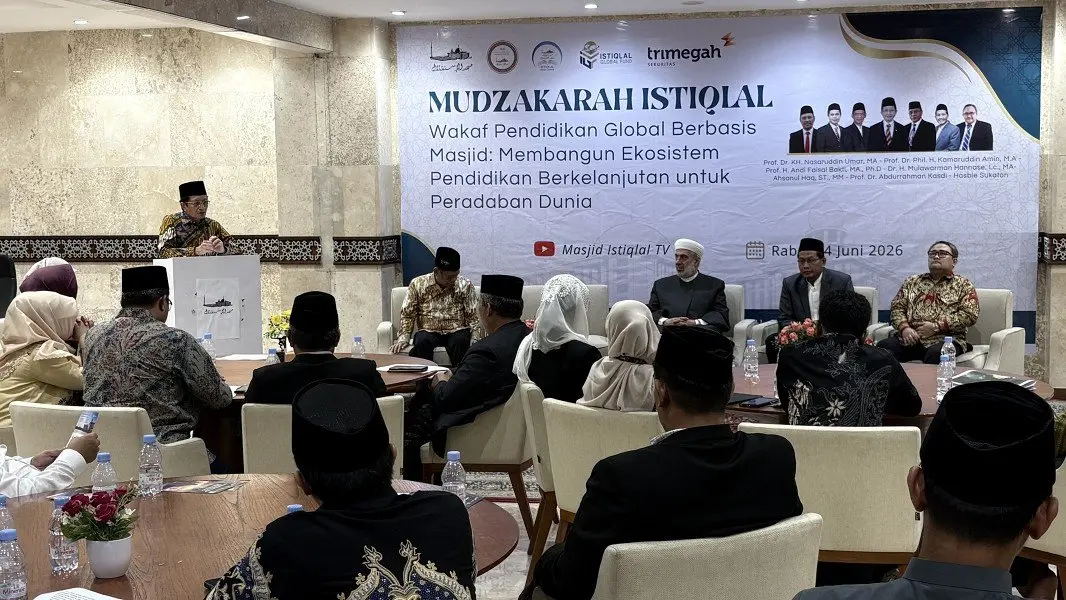
The Chairman of the Indonesian Association of Islamic Economists (IAEI), who is also the Minister of Religious Affairs of the Republic of Indonesia, Prof. Nasaruddin Umar, emphasized the importance of strengthening educational waqf as a strategic instrument for building high-quality human resources and a sustainable civilization. He made these remarks during the Istiqlal Symposium titled “Global Mosque-Based Educational Waqf: Building a Sustainable Educational Ecosystem for World Civilization,” which took place at the Istiqlal Mosque on Wednesday (June 24).
In his remarks, the IAEI Chairman emphasized that a nation’s progress is determined not only by the abundance of its natural resources but primarily by the quality of its people. Therefore, investment in education must be a top priority in national development. According to him, Islam has provided a strong foundation through religious social funding mechanisms, including zakat and waqf, which can be optimized to strengthen the education sector.
“Education is a long-term investment that shapes the nation’s future. Therefore, the potential of zakat and waqf must be managed more productively so that they can produce a generation that is outstanding, competitive, and of noble character,” said Prof. Nasaruddin Umar.
Prof. Nasaruddin also emphasized that Islam is a faith that upholds the values of humanity, justice, and respect for human dignity. In the Indonesian context, the success of the Walisongo’s da’wah demonstrates that the development of civilization can proceed in harmony with local values, thereby producing inclusive and sustainable social transformation.
In line with this vision, the Istiqlal Symposium underscored the importance of building a strong educational waqf ecosystem through the development of an educational endowment fund, enhancing the professionalism of waqf management, and strengthening collaboration among religious institutions, the government, academics, and the community.
On the same occasion, Dr. H. Mulawarman Hannase, Lc., M.A., explained efforts to develop the Istiqlal Endowment Fund as a long-term funding source for educational programs, leadership development, and human resource development. According to him, the success of various Islamic educational institutions worldwide demonstrates that professionally managed waqf can serve as the foundation for the sustainability of educational institutions across generations.
Meanwhile, Prof. Dr. Abdurrahman Kasdi emphasized the need to transform waqf management from a consumptive approach to a productive one. He explained that waqf must be viewed as an instrument of empowerment capable of supporting education, research, and community development in a sustainable manner. The experiences of various global centers of Islamic scholarship, such as Al-Qarawiyyin University and Al-Azhar, serve as evidence that productive waqf can sustain educational progress for centuries.
Concluding the series of discussions, this forum—which brought together scholars, academics, practitioners, and waqf administrators—agreed that strengthening educational waqf is a strategic agenda for accelerating the development of Indonesia’s human resources. In line with the guidance of the IAEI Chairman, waqf needs to be developed not only as an instrument of philanthropy but also as a development tool capable of fostering educational self-reliance, strengthening the academic ecosystem, and promoting a just, inclusive, and sustainable civilization.
“Productive waqf for education is an investment in civilization. From this will emerge an outstanding generation capable of leading Indonesia and the Islamic world toward a more advanced and dignified future,” emphasized the Chairman of IAEI.
-extra_small.jpg)