
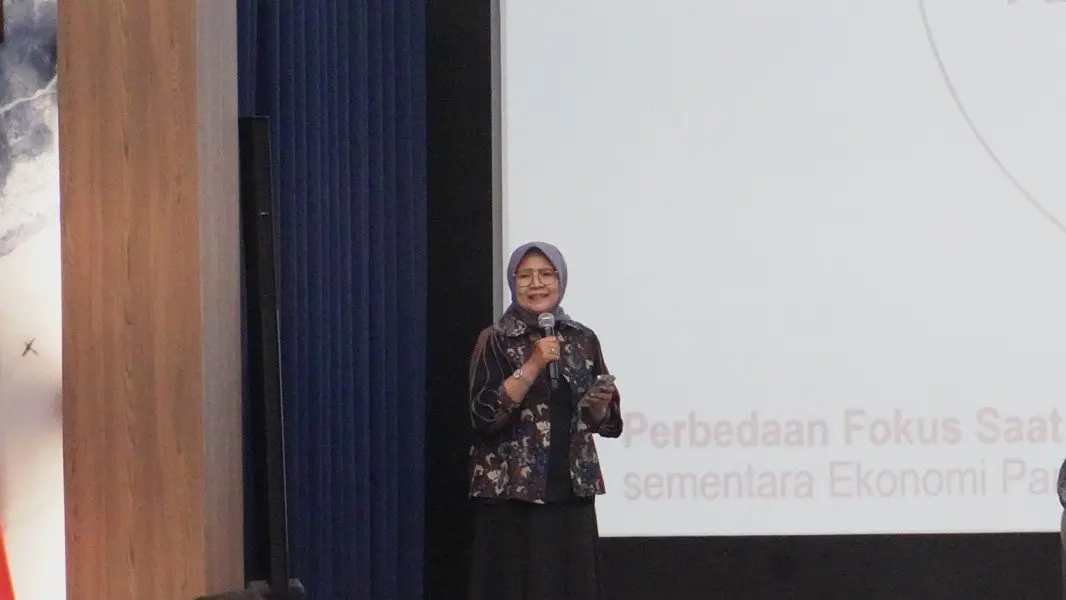
Dr. Hendri Saparini, Vice Chair of the Expert Council of the Indonesian Association of Islamic Economists (IAEI), urged that the values of Pancasila not remain merely a normative foundation but be translated more concretely into the national economic system, including through economic policies and institutions. Hendri conveyed this message at the IAEI National Symposium on Tuesday (September 8) in the Graha Sawala Room, Ali Wardhana Building, Coordinating Ministry for Economic Affairs of the Republic of Indonesia, Jakarta.
Hendri explained that the Pancasila-based economy shares several values that align with Islamic economics. Among them are religiosity, transcendental responsibility, sustainability, concern for the environment, and regulations regarding ownership.
According to Hendri, these shared values can serve as a space for dialogue to bring together Islamic economics and the Pancasila-based economy. However, the main challenge lies in how these values are translated into economic systems and policies that can be effectively implemented.
“Islamic economics in Indonesia has only developed on the business side; it doesn’t address the economic system itself. How can we propose to the state that it regulate ownership so that it isn’t like it is now—marked by greed?” said Hendri.
In his view, broader discussions are needed in the future regarding how the principles of Islamic economics can contribute to the regulation of the economic system, including issues of ownership and the relationship between large and small economic actors.
In this context, Hendri cited Article 33 of the 1945 Constitution as a key foundation for translating the economic principles of Pancasila into policy. The Constitution, he argued, can serve as a bridge to connect economic values and objectives with more concrete policy designs and institutional frameworks.
This idea is part of the IAEI’s discussion on the possibility of synthesizing Islamic economics, Pancasila economics, and conventional economics. All three are seen as offering perspectives that can complement one another in shaping the direction of Indonesia’s economy.
It is hoped that this synthesis will not only prioritize efficiency and growth as goals of economic development but also strengthen justice, equity, sustainability, and the economic sovereignty of the people.