
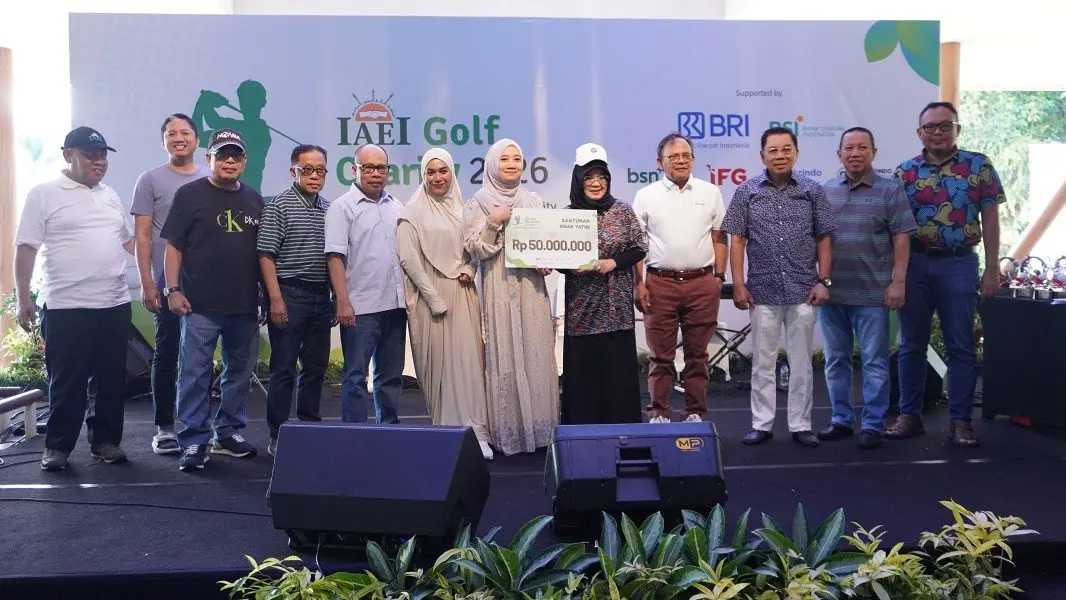
The Central Executive Board of the Indonesian Association of Islamic Economists (IAEI) reaffirmed its commitment to fostering an Islamic economy that provides tangible benefits to society through the IAEI Golf Charity 2026 event held in Bogor on Sunday (July 12). Embracing the spirit of collaboration and social responsibility, this event not only served as a gathering for stakeholders in the Islamic economy but also translated into concrete action through a charity program providing financial assistance to orphans.
This aid program embodies the values of Islamic philanthropy, which play a vital role in developing the Islamic economic ecosystem. Through synergy among academics, regulators, industry players, practitioners, and strategic partners, IAEI aims to ensure that every collaboration fosters not only ideas and networks but also delivers tangible benefits that the community can directly experience.
IAEI Chairman, Prof. Dr. Nasaruddin Umar, emphasized that the IAEI Golf Charity is a manifestation of transforming a sporting event into an Islamic philanthropic movement that embodies the value of i'anah (mutual assistance in goodness) as one of the foundations of the Islamic economy.
“Golf for Charity is not merely a sporting event, but an Islamic philanthropic movement that embodies the spirit of i'anah. Through aid provided to orphaned children, we want to ensure that every collaboration we build delivers tangible benefits and becomes part of our efforts to bring about the greater good for society,” stated the Chairman.
According to the Chairman, the Islamic economy is not only measured by the growth of the Islamic finance sector or the halal industry, but also by the extent to which the values of justice, compassion, and public benefit are realized in society. Therefore, Islamic philanthropy through various social programs serves as a crucial instrument in strengthening inclusive and equitable well-being.
The orphan support program as part of the IAEI Golf Charity 2026 serves as a symbol of a shared commitment to creating sustainable social impact. The aid distributed to Yayasan Jabal Quran Indonesia, is expected to help meet the needs of the beneficiaries while also serving as a reminder that the development of the Islamic economy must always go hand in hand with concern for vulnerable communities.
Through this initiative, IAEI also invites all stakeholders to continue strengthening a culture of sharing and collaboration in building a sharia economic ecosystem that is not only economically advanced but also makes a tangible contribution to improving the well-being of the community.
IAEI believes that every collaborative effort grounded in the spirit of i'anah will yield broader benefits. By making philanthropy an integral part of this collective movement, the Islamic economy is expected to become increasingly capable of providing solutions to various social challenges while realizing sustainable well-being for the people of Indonesia.