
.jpg-converted.jpeg)
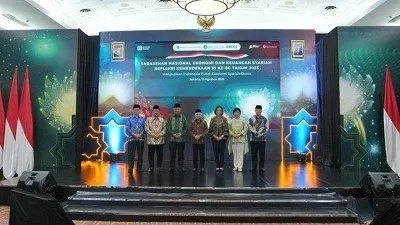
The Central Executive Board of the Indonesian Association of Islamic Economists (IAEI) brought together perspectives from conventional economics, Islamic economics, and Pancasila economics at a national symposium to formulate a direction for Indonesia’s economic development that is more just, inclusive, and sustainable, on Tuesday (September 8) at the Graha Sawala Hall, Ali Wardhana Building, Coordinating Ministry for Economic Affairs of the Republic of Indonesia, Jakarta.
The symposium, attended by Coordinating Minister for Economic Affairs Airlangga Hartarto and Minister of Religious Affairs and IAEI Chairman Prof. Nasaruddin Umar, emphasized the importance of finding common ground among economic perspectives rather than pitting them against one another.
Prof. Nasaruddin Umar emphasized that the Islamic economy must be viewed as more than just the development of the financial industry. The economic potential of the Muslim community—including zakat, infaq, sadaqah, and waqf—is seen as capable of becoming a productive economic force if managed in an integrated manner.
“The economic potential of the Muslim community must be managed in a more integrated manner so that it does not remain merely potential, but truly becomes an economic force that benefits society,” said Prof. Nasaruddin.
From the government’s perspective, Airlangga Hartarto emphasized the importance of maintaining the momentum of economic growth while expanding public access to economic and financial activities.
“We must continue to drive economic growth, but at the same time ensure that access to and the benefits of development are felt more equitably by the public,” Airlangga stressed.
The government is also promoting a number of policies to expand financial inclusion, including strengthening individual bank accounts, the Sharia KUR (Small Business Credit Program), developing Bank Syariah Indonesia as a bullion bank, and enhancing digital payments for MSMEs.
The forum discussed how the strengths of each paradigm can be synergized to address Indonesia’s economic challenges, ranging from growth, equitable distribution, inequality, strengthening MSMEs, to optimizing the economic potential of the Muslim community.
Prof. Bambang Juanda noted that contemporary conventional economics can serve as a scientific tool to evaluate the implementation of the values of justice and the common good in policy. Meanwhile, Dr. Hendri Saparini highlighted the absence of a national economic blueprint that is comprehensively grounded in Pancasila and the constitution, and Dr. Hendri Tanjung emphasized the importance of Islamic economics in promoting social justice and the economic empowerment of the Muslim community.
Prof. Didin Damanhuri then proposed a synthetic framework by drawing on the strengths of each approach: efficiency from conventional economics, justice and morality from Islamic economics, and solidarity and sovereignty from Pancasila economics. This synthesis is aimed at fostering productive, inclusive, and socially just growth.
Closing the symposium, Coordinating Minister Airlangga expressed his hope that the IAEI would continue to serve as a driving force for collaboration in the Islamic economy by connecting ideas, policies, and the Islamic economic ecosystem. It is hoped that this symposium will yield constructive recommendations for Indonesia’s inclusive, sustainable, and socially just development.