
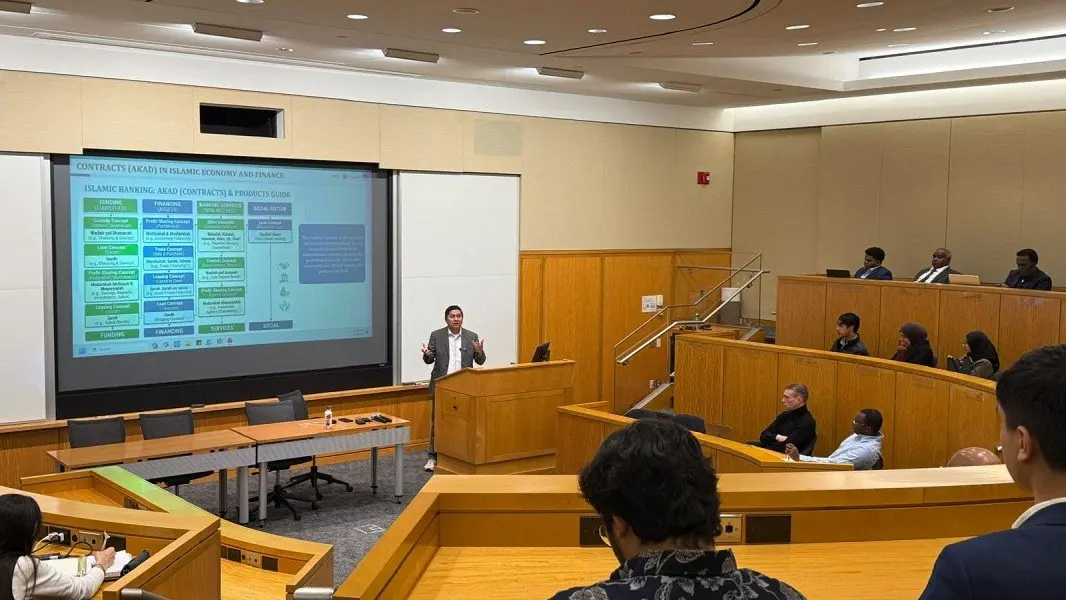
The Secretary General of the Indonesian Association of Islamic Economists (IAEI), who also serves as Director of the Sharia Ecosystem Infrastructure at the National Committee for Sharia Economics and Finance (KNEKS), Dr. Sutan Emir Hidayat, introduced the concepts, ecosystem, and developments of Indonesia’s Islamic economy and finance during a session titled “Introduction to Islamic Economy and Finance: Concepts, Ecosystem, and Indonesia’s Experience” held at Harvard University, Thursday (September 26)
In his presentation, Sutan Emir explained that Islamic economy and finance constitute an economic system grounded in Sharia principles, which is inclusive and universal, and encompasses all sectors of the economy—both the financial and real sectors. Islamic economy and finance are aimed at achieving prosperity for all humanity by upholding the values of justice and sustainability.
These principles are reflected in the values of justice (‘adl), balance (tawazun), public interest (maslahah), brotherhood (ukhuwah), morality (akhlak), and the attainment of falah. Within this framework, Islamic economics does not merely focus on the halal status of a product or activity but also ensures that economic activities provide broader benefits to society.
Sutan Emir also explained the connection between Islamic economics and finance and the concept of Maqashid al-Sharia, which encompasses five key aspects that must be safeguarded in human life: religion (din), life (nafs), reason (‘aql), lineage (nasl), and wealth (mal). Thus, the development of the Islamic economy is directed not only toward halal economic activities but also toward the creation of social and economic well-being that is just, ethical, and sustainable.
Within the financial ecosystem, the Islamic economy and finance encompass various sectors, including Islamic banking, the Islamic capital market, Islamic insurance, and non-bank financial institutions such as Islamic fintech, multifinance, microfinance, venture capital, Islamic pawnshops, and Baitul Maal wat Tamwil (BMT). The akad serves as one of the primary instruments distinguishing Sharia transactions from conventional systems, particularly in the management of risk, profit, and ownership among parties.
In the Indonesian context, KNEKS plays the role of an orchestrator in the development of the national Sharia economic and financial ecosystem. Strengthening this ecosystem is part of the effort to support the national economic growth target of 8 percent through the development of various Sharia economic sectors.
One of the main pillars of Indonesia’s Sharia economy is the development of the Halal Value Chain (HVC). In the first quarter of 2026, the HVC sector contributed 26.07 percent to the Gross Domestic Product (GDP), equivalent to Rp1,613 trillion, with year-on-year growth of 6.8 percent. This growth was driven by the agriculture, halal food and beverage, fashion, and tourism sectors.
In the Muslim-friendly tourism sector, Indonesia ranked second in the 2026 Global Muslim Travel Index (GMTI) with a score of 78. This sector contributed 5.62 percent to GDP—or approximately Rp347 trillion—in the first quarter of 2026, with a year-on-year growth rate of 2.22 percent. The development of this sector continues to be driven by the strengthening of halal service standards, certification, international promotion, and collaboration between the government, industry, travel platforms, and technology providers.
Progress is also evident in the halal industry and the trade of halal products. The value of Indonesia’s halal product exports reached USD63.42 billion in 2025, marking the highest figure in the 2020–2025 period. The contribution of halal product exports to GDP increased from 3.69 percent in 2024 to 4.39 percent in 2025, with the food and beverage sector accounting for 84.39 percent of total halal product exports.
In terms of Islamic finance, total Islamic financial assets reached Rp10,662 trillion as of April 2026, growing 6.4 percent year-on-year. This figure consists of Islamic capital market assets of Rp9,178.71 trillion, Islamic banking assets of Rp1,055.26 trillion, and Islamic non-bank financial industry assets of Rp428.11 trillion. The ratio of Islamic financial assets to GDP also reached 51.78 percent in December 2025, exceeding the RPJMN target of 45.38 percent.
Strengthening financing for MSMEs is a key component in the development of this ecosystem. Sharia financing for MSMEs reached Rp172.37 trillion in March 2026, while Islamic-compliant Securities Crowdfunding (SCF) reached Rp1.08 trillion, with a growth rate of 45.84 percent. KNEKS is also promoting the diversification of financing contracts through the “Beyond Murabahah” campaign to expand the use of profit-sharing and salam-based schemes.
In addition to commercial finance, Sharia social finance constitutes a vital part of the ecosystem. The collection of Sharia social funds—comprising zakat, infaq, sadaqah, and waqf—reached IDR 5.7 trillion in the first quarter of 2026, while cash waqf assets totaled IDR 4.71 trillion. Issuances of Cash Waqf Linked Sukuk (CWLS) have reached 15 series with a cumulative value of IDR 1.47 trillion, whereas Cash Waqf Linked Deposits (CWLD) have totaled 21 products valued at IDR 11.7 billion.
A presentation at Harvard University underscored that Indonesia’s Sharia economy and finance sector possesses a vast and expanding ecosystem, encompassing the real sector, the halal industry, Muslim-friendly tourism, trade, commercial finance, MSME financing, and social finance. Moving forward, strengthening ecosystem integration, access to financing and investment, regulations, contribution measurement, and stakeholder collaboration will be crucial to optimizing the potential of the Sharia economy and finance as a driver of national economic growth.