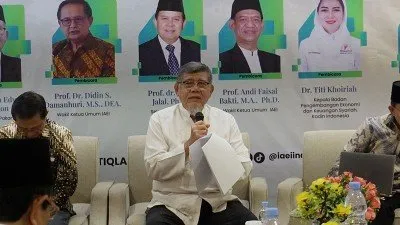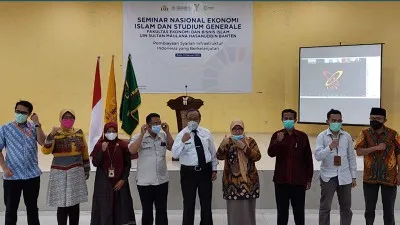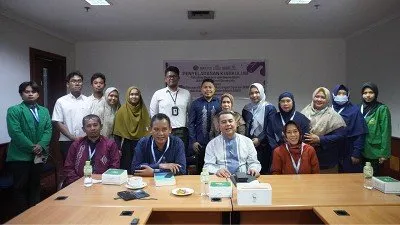


The Chair of the Islamic Social Finance Development Committee of the Indonesian Association of Islamic Economists (IAEI), Dr. Hendri Tanjung, advocates for strengthening zakat, infaq, sadaqah, and waqf (ZISWAF) as strategic instruments to reduce economic inequality and strengthen community self-reliance. According to him, Islamic social finance needs to be directed not only toward meeting short-term needs but also toward serving as a means of economic empowerment so that beneficiary communities can achieve sustainable upward mobility. Hendri conveyed this message at the IAEI National Symposium on Tuesday (September 8) in the Graha Sawala Room, Ali Wardhana Building, Coordinating Ministry for Economic Affairs of the Republic of Indonesia, Jakarta.
According to Hendri, the Islamic economy strikes a balance between individual interests and social responsibility. Islam recognizes individual ownership but, at the same time, imposes social obligations through instruments such as zakat.
“In the Islamic economy, individual ownership is recognized, but there are social obligations embedded within it. Zakat serves as one of the instruments to ensure that wealth does not circulate exclusively among certain circles,” said Hendri.
Hendri believes that zakat should be provided in amounts and forms that enable recipients (mustahik) to build sustainable sources of income. “If recipients are given enough zakat to serve as business capital, then the ultimate goal is not merely to help them today, but to enable them to become self-reliant and, in time, become zakat contributors (muzaki) themselves,” he explained.
Hendri also emphasized the importance of linking Islamic social finance with the development of the real sector. In his view, Islamic economic policies need to show stronger support for small and medium-sized enterprises so that the benefits of development are not enjoyed solely by large economic groups.
In this context, digital technology can serve as a means to expand public access to financing sources. He believes that the development of Sharia-compliant fintech can be leveraged to reduce the capital barriers that MSMEs have long faced.
Furthermore, Hendri introduced the concept of “Ma’rufnomics” as a vision to invert the economic pyramid. Within this framework, development should not merely rely on the hope that growth among the upper economic groups will eventually trickle down to the lower groups through the trickle-down effect.
From this perspective, ZISWAF holds a strategic position because it directly carries out the mission of redistribution and empowerment. More productive management can make Islamic social finance one of the instruments for strengthening the economic foundation of society from the bottom up.
As Chair of the IAEI’s Islamic Social Finance Development Committee, Hendri believes that strengthening ZISWAF requires collaboration among various parties, ranging from the government, zakat collection agencies, waqf trustees, the Islamic finance industry, academics, businesspeople, to the general public.
By strengthening this ecosystem, the IAEI encourages the Islamic economy to grow not only through the commercial finance sector but also through social finance capable of generating direct benefits for the community.