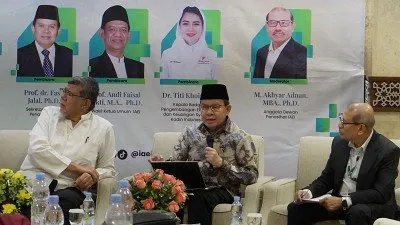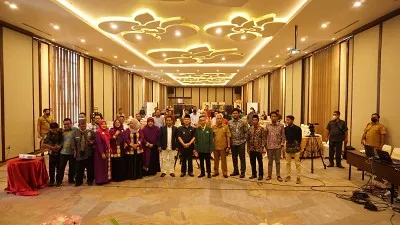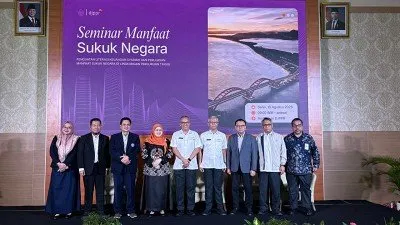

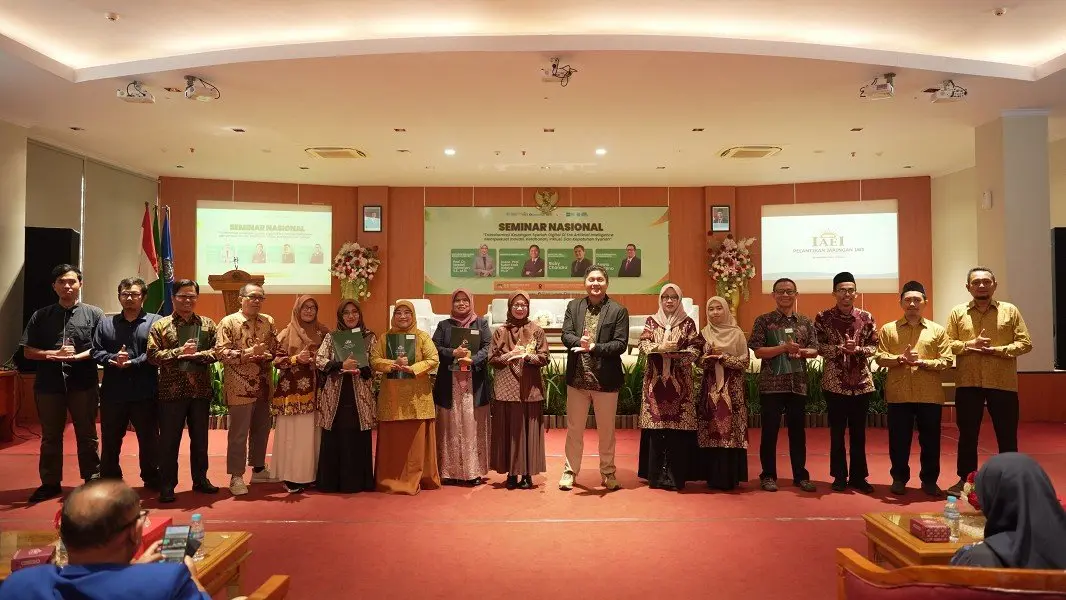
The Regional Executive Board of the Indonesian Association of Islamic Economists (IAEI) Central Java is promoting the strengthening of a digital sharia finance ecosystem that is innovative, inclusive, resilient, and remains grounded in sharia principles amid the development of Artificial Intelligence (AI). These efforts are also part of the organization’s consolidation to strengthen IAEI’s contribution to the development of the Islamic economy and finance, through the Regional Conference, National Seminar, and Branch Inauguration at IAEI Central Java under the theme “Digital Islamic Finance Transformation in the Era of Artificial Intelligence: Strengthening Innovation, Resilience, Inclusion, and Sharia Compliance,” on Wednesday (September 9) at Muhammadiyah University of Purwokerto.
The Chair of the IAEI Central Java Regional Executive Board (DPW), Prof. Naelati Tubastuvi, stated that technological developments, particularly AI, have brought about major changes in education and the financial industry. “This theme emphasizes four key areas: innovation, resilience, Islamic financial inclusion, and Sharia compliance,” said Prof. Naelati.
IAEI Secretary-General, Assoc. Prof. Sutan Emir Hidayat, Ph.D., highlighted the immense opportunities that digitalization presents for the development of Sharia finance. Global Sharia financial assets are projected to reach USD 3.88 trillion by 2024, while in Indonesia, total Sharia financial assets as of August 2026 are projected to reach Rp 1,070.72 trillion.
According to Sutan Emir, advancements in AI open up opportunities for leveraging technology in credit scoring, KYC, fraud detection, risk management, as well as RegTech and SupTech. However, these innovations must be balanced with attention to data security, algorithmic bias, transparency, and potential uncertainties in decision-making.
“The digital transformation of Islamic finance must strengthen innovation, resilience, inclusion, and Sharia compliance,” he emphasized.
From the regulator’s perspective, Ricky Chandra of the Financial Services Authority (OJK) explained that the development of digital innovations and digital financial assets must be accompanied by adequate regulations, governance, and consumer protection. Through Law No. 4 of 2023 on P2SK, the OJK has been mandated to regulate and supervise Digital Financial Assets, including cryptocurrencies.
The OJK is also continuing to develop an AI governance framework that emphasizes the principles of utility, fairness, accountability, transparency, security, and the ability to explain decision-making processes. “AI cannot be evaluated solely based on accuracy. Oversight also assesses the purpose of use, fairness, accountability, transparency, security, and consumer protection mechanisms,” said Ricky.
Meanwhile, the Head of Bank Indonesia’s Purwokerto Representative Office, Aswin Gantina, outlined Bank Indonesia’s role as an Accelerator, Initiator, and Regulator (AIR) in the development of the Islamic economy and finance. Through the BI 2030 Islamic Finance Policy Framework, the development of the Islamic economy is directed toward strengthening the halal value chain, optimizing Islamic financing, and expanding financial literacy and inclusion.
In the Greater Banyumas region, these efforts are being realized through the development of halal products, the strengthening of Islamic social finance, business matching for Islamic financing, and digitalization. QRIS also serves as one of the instruments to expand financial inclusion, including for payments of zakat, infaq, sadaqah, and waqf.
This series of activities underscores the importance of collaboration among academics, regulators, practitioners, universities, organizations, and the public in navigating the digital transformation. Through organizational consolidation and the promotion of innovation, the Central Java Chapter of the Indonesian Association of Islamic Economists (IAEI) advocates that advancements in AI and the digitalization of Islamic finance not only yield efficiency but also bring public welfare and tangible benefits to society.
“This forum goes beyond the exchange of ideas; it can generate relevant recommendations for policy development, research, and community service,” concluded Prof. Naelati.
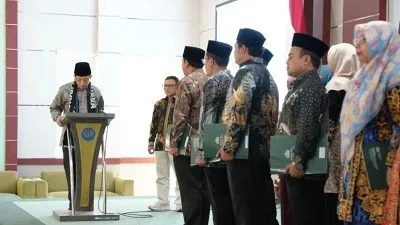
In line with this, organizational consolidation is a crucial component in strengthening the IAEI Central Java chapter, which currently comprises 23 local chapters. Organizational strengthening is carried out through capacity building for the Provincial Executive Board (DPW), network expansion, and reactivation via the inauguration of the executive boards of 8 IAEI branches in Central Java, including Muhammadiyah University of Purwokerto, IAI Nadhlatul Ulama Kebumen, Tidar University, Pancasakti University of Tegal, UIN K.H. Abdurrahman Wahid Pekalongan, STAI Sayubbanul Wathon in Magelang, STIES Putera Bangsa, and Nahdlatul Ulama University in Jepara.