
The Indonesian Association of Islamic Economists (IAEI), together with the Directorate General of Financing and Risk Management (DJPPR) of the Ministry of Finance, is encouraging universities to expand the use of Government Sukuk as an instrument for managing endowment funds while also strengthening Islamic financial literacy on campus. These efforts are considered crucial for building financial independence while ensuring that the management of endowment funds provides sustainable benefits for national education.
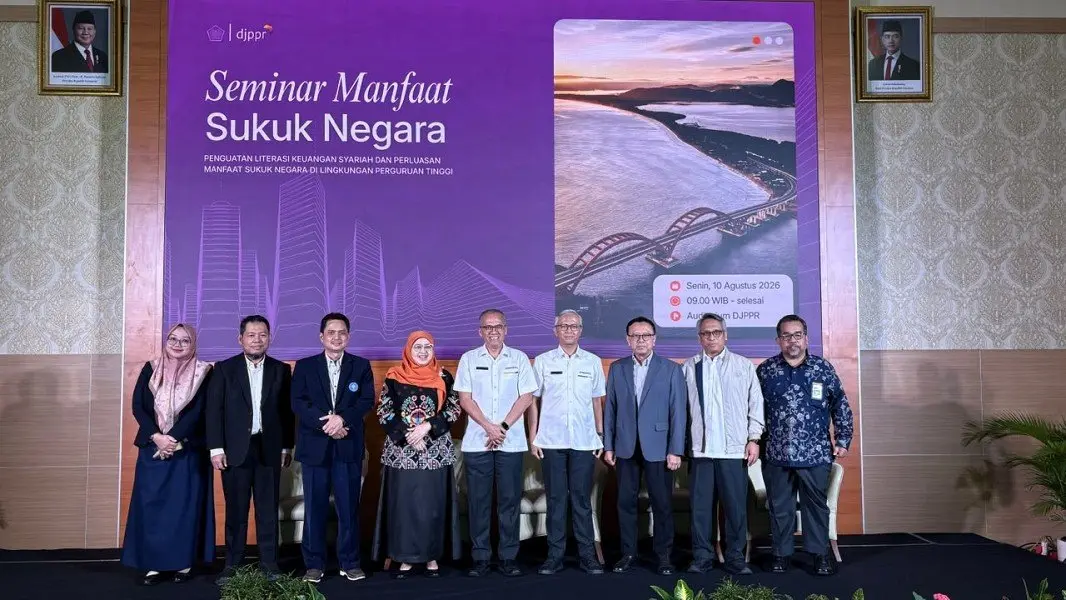
This initiative was highlighted during the Seminar on the Benefits of Government Sukuk titled “Strengthening Sharia Financial Literacy and Expanding the Benefits of Government Sukuk in Higher Education Institutions,” held in a hybrid format at the DJPPR Auditorium, Frans Seda Building, Jakarta, on Monday (August 10). The event brought together government officials, academics, managers of university endowment funds, and the Indonesian Waqf Board to discuss strengthening the Sharia-based education financing ecosystem.
Mochamad Agus Rofiudin, Senior Advisor for Non-Tax State Revenue at the Ministry of Finance, stated that enhancing financial literacy is a crucial component in expanding the use of Sharia financial instruments. Amid global uncertainty, Indonesia is considered to hold a strategic position in the development of the global Islamic finance market, including through State Sukuk.
“State Sukuk has become a pillar of development, with total issuances reaching Rp1,700 trillion. If development is the goal, then education is its foundation. We position universities as central hubs for literacy, research, and strategic partners of the government,” said Agus Rofiudin.
Dr. Deni Ridwan, Director of Sharia Financing at the Ministry of Finance’s DJPPR, explained that State Sukuk offer benefits in two dimensions. First, as an institutional instrument that supports measured financial management. Second, as an investment instrument that provides opportunities for the public to participate in financing development.
In the context of higher education, the use of State Sukuk as part of endowment fund management is beginning to show concrete examples. “In Indonesia, there are three universities that have managed their endowment funds through State Sukuk instruments: IPB University, Telkom University, and the Open University. This is tangible evidence of how sukuk has become a vital pillar in the campus financial ecosystem,” explained Deni Ridwan.
In terms of strengthening financial literacy, Prof. Euis Amalia, Chair of the Human Resources Development, Economics, and Sharia Finance Division at the IAEI Central Executive Board, highlighted the persistent gap between public understanding of and actual use of sharia financial services.
“Our sharia financial literacy stands at 43.07 percent, yet financial inclusion remains alarmingly low at 13.24 percent. This indicates that there is not yet a significant correlation between understanding and practice. All universities must serve as agents to bridge this gap,” emphasized Euis Amalia.
Prof. Euis also cited the development of Cash Waqf Linked Sukuk (CWLS) at UIN Syarif Hidayatullah as an example of innovation that combines waqf instruments with government sukuk. This scheme demonstrates that the development of social funds and Islamic financial market instruments can be directed toward creating both economic and social benefits simultaneously.
Prof. Alla Asmara, Head of the Waqf and Social Funds Unit at IPB University, also shared higher education institutions’ experiences in managing endowment funds and waqf. According to her, State Sukuk offer characteristics well-suited to supporting the management of endowment funds because they provide certainty and security in long-term investment planning.
Meanwhile, M. Ali Yusuf, Commissioner of the Indonesian Waqf Board and Chair of the Waqf Management and Development Division, assessed that the potential for developing waqf-based endowment funds remains very significant. This ecosystem is supported by 548 cash waqf trustees and 65 Islamic banks that can play a role in strengthening collaboration between the management of cash waqf and State Sukuk instruments.
From a portfolio management perspective, Suharianto, Chair of the SBSN Portfolio Management Task Force at the Directorate General of State Budget and Public Debt (DJPPR) of the Indonesian Ministry of Finance, emphasized that State Sukuk can be one option for universities to manage funds productively. In addition to offering competitive returns, funds raised through State Sukuk also support the financing of infrastructure development and real-sector projects that benefit the public.
The seminar underscored that the development of university endowment funds is not only related to investment aspects but also concerns the development of a sustainable education financing ecosystem. State Sukuk, cash waqf, and endowment funds can be developed synergistically to strengthen universities’ financing capacity while creating broader social and economic impacts.
Through collaboration between the Directorate General of State Budget and Public Debt (DJPPR) of the Ministry of Finance, the Indonesian Association of Islamic Economists (IAEI), the Indonesian Waqf Board, and universities, the strengthening of endowment funds is expected to serve as a model for the development of long-term, Sharia-based education financing. This ecosystem is designed not only to strengthen the financial independence of universities but also to support the funding of the Three Pillars of Higher Education and national development through productive Sharia investment instruments.