
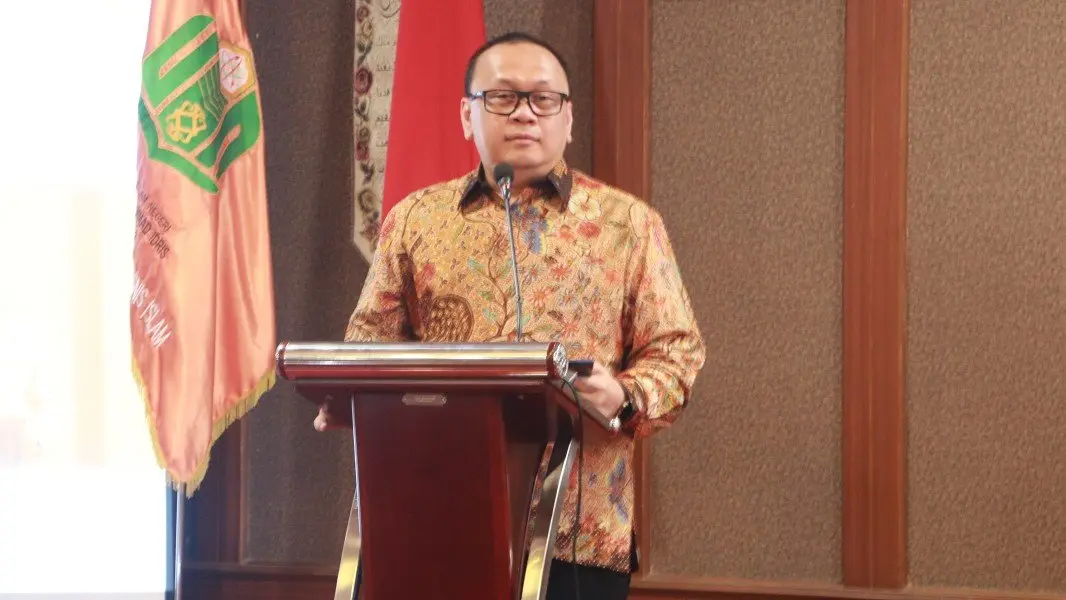
Islamic economics has the potential to strengthen financing for sustainable development through the optimization of Islamic finance, zakat, waqf, and green financing. This potential needs to be integrated into the national development agenda to expand economic benefits and improve public welfare. This was stated by the Deputy Chairman of the Indonesian Association of Islamic Economists (IAEI), Prof. Irfan Syauqi Beik, at The 3rd Annual International Conference on Islamic Economics and Finance (AICIEF) 2026, on Thursday (October 15), at the Grand Sawit Hotel in Samarinda.
In his presentation, Prof. Irfan highlighted the massive financing needs for the transition to a low-carbon economy by 2060, amounting to Rp794.6 trillion per year, with a financing gap reaching Rp458.2 trillion per year.
“Islamic economics possesses instruments capable of supporting the financing of sustainable development, whether through sharia-compliant commercial finance or Islamic social finance. The challenge lies in optimizing this potential so that it can meet financing needs while simultaneously expanding economic benefits for the community,” said Prof. Irfan Syauqi.
Prof. Irfan explained that Sharia finance can contribute through asset-based financing and a focus on welfare. Meanwhile, zakat and waqf have the potential to support social programs, economic empowerment, and long-term development. This approach aligns with the Maqasid al-Sharia and the Sustainable Development Goals (SDGs), particularly in promoting inclusive growth and strengthening social and environmental resilience.
Prof. Irfan also highlighted the potential of national zakat at Rp327.6 trillion and the potential of cash waqf at Rp180 trillion. Zakat can support poverty alleviation and economic empowerment, while waqf has the potential to be developed to finance long-term programs. Both can complement commercial financial instruments in strengthening community resilience.
In addition, Prof. Irfan emphasized the importance of integrating the development of Islamic economics and finance into both national and regional development planning. Strengthening the halal industry, exports, Islamic finance, and Islamic social finance requires coordination among the government, universities, financial institutions, zakat and waqf administrators, and business actors.
For the IAEI, this presents an opportunity to contribute through research, policy recommendations, public education, and human resource capacity building. Cross-sectoral synergy is expected to link the potential of the Islamic economy with development needs, while promoting inclusive and sustainable economic resilience.