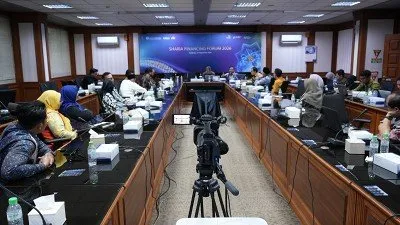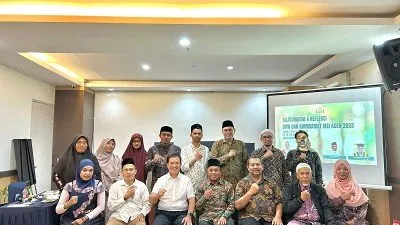

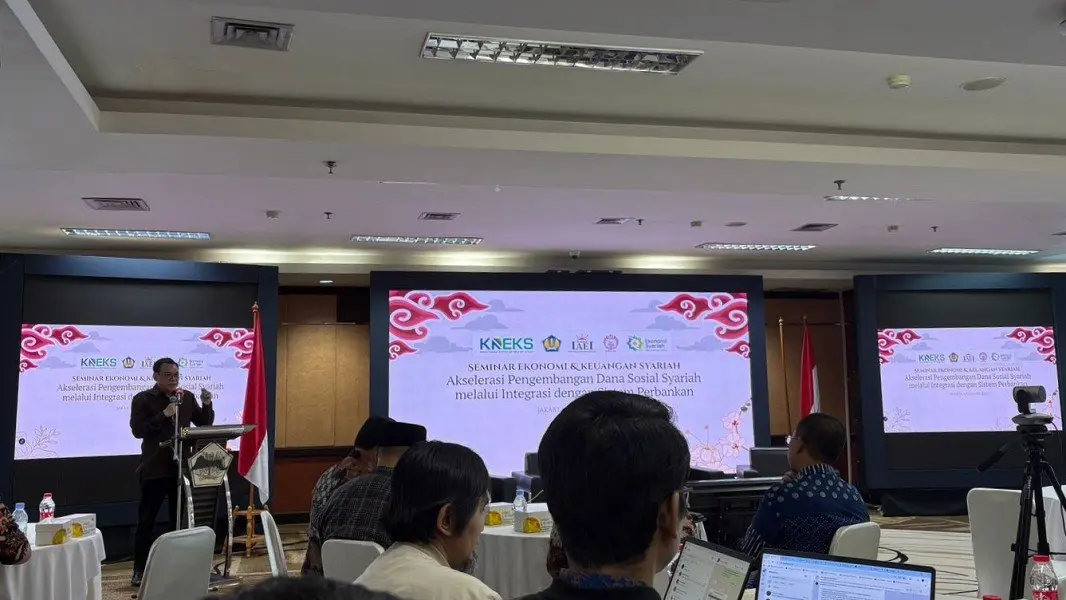
The Central Executive Board of the Indonesian Association of Islamic Economists (IAEI), together with the Secretariat of the National Committee for Islamic Economics and Finance (KNEKS) and the Alumni Association of the Doctoral Program of the Faculty of Law, University of Indonesia (ILUNI S3 FH UI), held a seminar on Accelerating the Development of Islamic Social Funds through Integration with the Banking System, on Friday, February 6, 2026, at the Soetikno Slamet Building Hall, Jakarta.
The seminar aimed to gather input from experts and practitioners regarding the potential, regulations, and policies for integrating Islamic social funds into the national banking system. The integration of sharia social funds, which include zakat, infaq, sadaqah, and waqf (ZISWAF), with the sharia banking system is very important to strengthen social impact, expand financial inclusion, and strengthen the sharia economic ecosystem.
Dr. Arif Wibisono, Head of the KNEKS Secretariat, highlighted in his speech the significant gap between the potential and realization of Islamic social funds in Indonesia. Despite the enormous potential of ZISWAF, the realization of its collection has only reached IDR 35.01 trillion.
“This figure is not yet commensurate with the potential of the community and national social needs. As a result, social funds have not been optimally utilized to address poverty and inequality,” said Arif Wibisono.
Arif also emphasized that waqf should not be viewed solely as a social instrument, considering that the potential for cash waqf reaches IDR 180 trillion, while the realization of cash waqf through the capital instrument market, namely Cash Waqf Linked Sukuk (CWLS), has reached IDR 1.47 trillion and through banking instruments through Cash Waqf Linked Deposits amounting to IDR 16.39 billion. “Waqf and other sharia social instruments are a major asset of the people that must be managed productively and professionally,” he said.
The Chairman of the IAEI Islamic Social Finance Development Committee, Dr. Hendri Tanjung, explained that the integration of social and commercial sharia finance must be carried out holistically, without a dichotomy between profit orientation and welfare. “The ultimate goal of Islamic finance is to realize maqashid syariah. This integration actually strengthens the social function and sustainability of the financial system,” he said.
He highlighted the role of waqf as a source of sustainable funding that can be used for MSME financing, public infrastructure development, and expansion of financial services for the unbankable. According to him, this integration also contributes to the stability of the national financial system.
From a regulatory perspective, Prof. Dr. Wicipto Setiadi from ILUNI FH UI assessed that Law Number 41 of 2004 concerning Waqf is not yet fully responsive to the development of large-scale cash waqf and its integration with the modern Islamic financial system. He emphasized that strengthening the governance of Nazir, harmonizing institutional authority, and protecting waqf assets must be the main focus, while avoiding regulatory overlap.
In addition, the Director of Sharia Social Finance at KNEKS, Dr. Dwi Irianti Hadiningdiyah, said that sharia economics and finance have become part of the national development agenda, including in the 2025-2045 RPJPN. The potential for zakat of Rp327 trillion and cash waqf of Rp180 trillion has not been optimally utilized.
“Sharia banking has a strategic role as a recipient of cash waqf, Nazir, as well as a provider of financing for the sharia economic ecosystem,” she said.
The discussion was also attended by academics, banking practitioners, and regulators, and concluded that the integration of ZISWAF and sharia banking is a strategic step to build an inclusive, sustainable sharia economic ecosystem that has a broad impact on national development.