

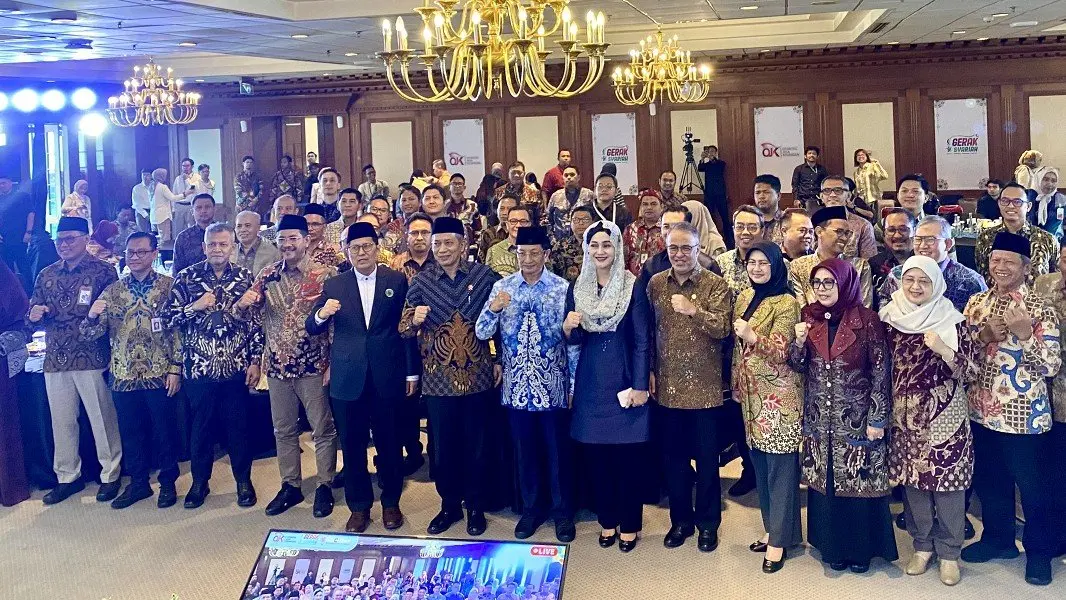
The closing ceremony of the 2026 Islamic Finance Ramadan Celebration (GERAKS), organized by the Financial Services Authority (OJK) on Thursday, April 2, 2026, provided a powerful opportunity for reflection on how Ramadan affects people's economic lives. On this occasion, the Chairman of the Indonesian Association of Islamic Scholars (IAEI) and Minister of Religious Affairs of the Republic of Indonesia, Prof. Dr. KH. Nasaruddin Umar, M.A., delivered the keynote speech, stating that Ramadan should not be viewed solely as a time for worship, but also as a period of intense economic activity.
Prof. Nasaruddin described how almost every activity during Ramadan has economic implications. From zakat al-fitr (almsgiving), to daily consumption such as breaking the fast and eating sahur (pre-dawn meal), to the phenomenon of returning home (mudik), money can flow from cities to villages. All of this forms a unique economic pattern that recurs annually. "If we index everything I've said into a single data column, we will see that the largest spending in Indonesia occurs during Ramadan," said the Chairman.
This demonstrates that Ramadan actually holds enormous economic potential. Simple activities such as breaking the fast together, purchasing Eid necessities, and even home renovations ahead of the holiday all contribute to the national economy. However, despite this potential, he also raised a serious concern. Indonesia's large Muslim population has not yet been fully matched by strong Islamic economic practices.
"We have 244 million Muslims, but only around 7.6 percent of them practice Islamic economic practices. That's still very low," Prof. Nasaruddin emphasized. This statement demonstrates the gap between potential and reality. Ramadan economic activity is indeed substantial, but not all of it is directed toward a structured and sustainable Islamic economic system.
In this context, Prof. Nasaruddin emphasized the importance of institutional roles, particularly collaboration between the Indonesian Association of Islamic Economic Experts (IAEI) and the Islamic Economic Community (Masyarakat Ekonomi Syariah). He explained that strengthening the ecosystem requires a clear division of roles between concept development and implementation on the ground. "The Islamic Economic Community must collaborate with the Association of Islamic Economists. The MES is the implementer, and the IAEI is the one preparing the scientific framework," he explained.
Furthermore, Prof. Nasaruddin also highlighted the gap between the concept of Islamic jurisprudence (fiqh) in muamalah (Islamic business) and modern economic practices. Differences in terminology and approaches often prevent the two from fully connecting. Therefore, the IAEI is currently promoting alignment, including through curriculum development to be more relevant to national policy and development needs.
Furthermore, Prof. Nasaruddin reminded that strengthening the Muslim economy cannot rely solely on zakat. There are other instruments that actually play a significant role, but have not been optimally utilized. "We cannot rely solely on zakat. In many countries, waqf (endowments) are the main driving force in the economic development of the Muslim community," he explained. Instruments such as infaq (donations), alms (sadaqah), and grants are also said to have ample scope to promote economic equality and empowerment, as long as they are managed properly and on target.
Interestingly, Prof. Nasaruddin Umar also observed that the economic impact of Ramadan is not limited to one group. The increased economic activity during this month is felt by all levels of society. "Those who benefit during Ramadan are not only Muslims, but everyone," Prof. Nasaruddin concluded.
The closing ceremony of the 2026 Islamic Finance Ramadan Celebration was ultimately more than just a finale. Ramadan served as a sign that the potential is clearly visible, but its development still requires more serious, structured work, involving multiple parties.
-extra_small.jpg)