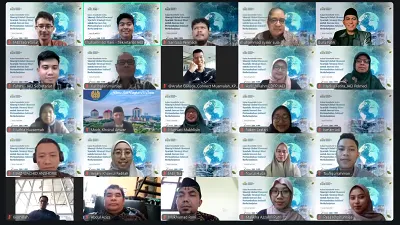

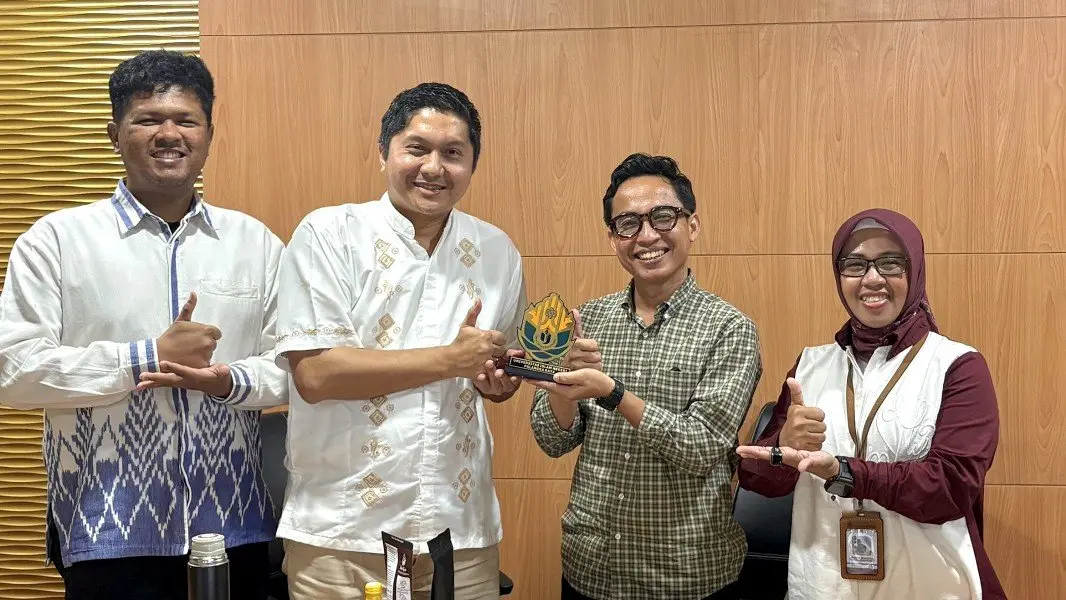
The Central Executive Board of the Indonesian Islamic Economists Association (IAEI) once again strengthened synergy in the development of human resources in Islamic economics by hosting a visit from Mr. Wahyu Akbar, M.E., Vice Dean III of the Faculty of Economics and Business of the State Islamic University (UIN) Palangka Raya. The main agenda was to discuss the establishment of an IAEI commissariat on the campus of the State Islamic University (UIN) Palangka Raya. The meeting, held in the Meeting Room of the IAEI Central Executive Board Office, was hosted by Assoc. Prof. Sutan Emir Hidayat, P.hD., Secretary General, and Ms. Mega Oktaviany, Ph.D., Secretary for Organizational Development, Regional Development, and Commissariats on Tuesday, March 31, 2026.
The visit took place in a warm atmosphere, with the main discussion focused on how to build a formal institutional foundation structurally and sustain it in daily student activities. In his presentation, Sutan Emir Hidayat highlighted the significant significance of the initiative to establish this commissariat, particularly in the context of expanding the IAEI network in Central Kalimantan. "This will be the first commissariat established in Central Kalimantan," said Sutan Emir Hidayat.
Meanwhile, Mega Oktaviany highlighted the importance of continuity between organizations at the campus level. Organizations such as KSEI and FoSSEI are considered crucial as initial cadre development spaces, and IAEI can serve as a bridge to a broader professional network. Collaboration between these organizations is key to ensuring the Islamic economic movement among students does not operate in isolation. In fact, the commissariat's main strength, beyond its organizational structure, lies in its ability to mobilize the student community. "KSEI and FoSSEI can serve as the initial foundation for IAEI's development on campus, ensuring a more structured and sustainable direction," Mega Oktaviany emphasized.
Furthermore, the newly formed IAEI Commissariat is expected to be active not only on campus but also to build external relationships from the outset with various regional economic institutions, such as Bank Indonesia, the Financial Services Authority, Regional Sharia Economic and Financial Committee (KDEKS), local governments, and the financial industry. This approach is considered crucial for opening up more concrete collaborations, ranging from educational activities and research to community empowerment programs.
From UIN Palangka Raya, Wahyu Akbar expressed his appreciation for the warm welcome from IAEI. He expressed his gratitude for the warm and open welcome. Furthermore, he emphasized that this initiative was inseparable from his personal passion as an alumnus of Islamic economics, his drive to contribute to the development of Central Kalimantan, and the support of the Rector of UIN Palangka Raya, Prof. Dr. H. Ahmad Dakhoir, M.H.I. Wahyu believes that strengthening networks like IAEI is a crucial starting point for optimal regional development through an Islamic economic approach. "Hopefully, with the IAEI UIN Palangka Raya commissariat, it can become a pioneer and catalyst for developing an Islamic economy in Central Kalimantan," said Wahyu Akbar.
The meeting's agenda went beyond conceptual discussions to concrete steps to strengthen the student community, map potential regional collaborations, and design work programs relevant to regional needs. This visit demonstrates that Islamic economic development cannot rely solely on policies or large institutions but also requires a growing movement within campuses and student communities. With the initiative to establish this commission, UIN Palangka Raya is expected to become one of the starting points for the birth of a more inclusive and sustainable sharia economic ecosystem in the Central Kalimantan region.