
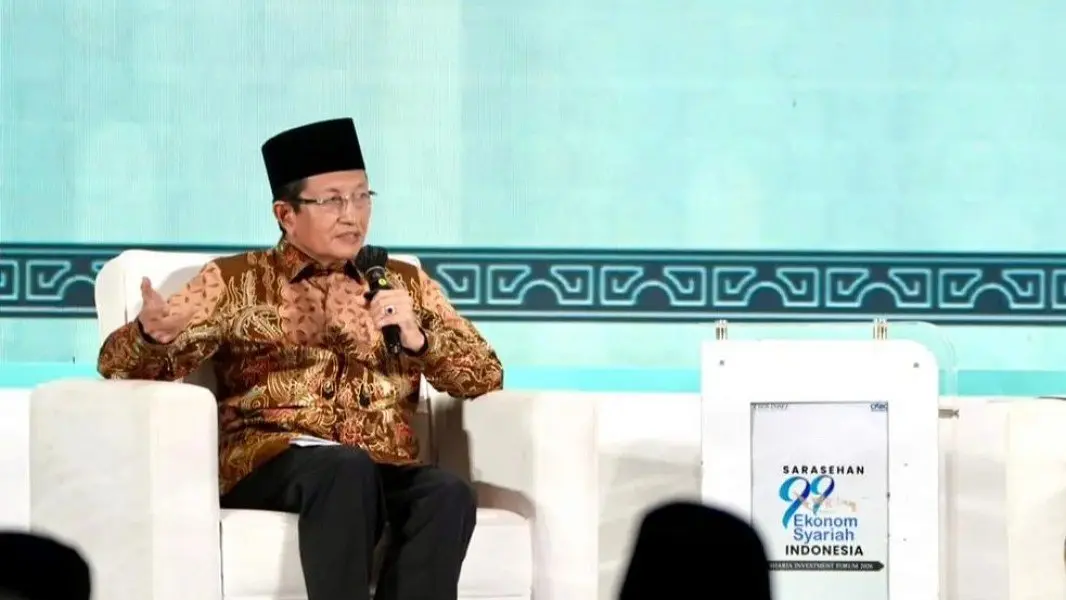
The Chairman of the Indonesian Association of Islamic Economists (IAEI), Prof. Dr. KH. Nasaruddin Umar, MA., was a guest speaker at the 99th Indonesian Sharia Economists Seminar at the 2026 Sharia Investment Forum held by the Center for Sharia Economic Development Institute for Development of Economics and Finance (CSED INDEF) with the theme “Prioritizing Sharia Economics as a New Pillar of National Economic Growth” on Tuesday, February 24, 2026, at Menara Bank Mega, which was also broadcast live on CNBC Indonesia TV.
In the forum, which highlighted the theme of mainstreaming Islamic economics as a new pillar of national economic growth, the Chairman of IAEI, who is also the Minister of Religious Affairs of the Republic of Indonesia, assessed that the financial potential of the Muslim community is still far from optimal. He reminded the audience that zakat has often been positioned as the mainstay of empowerment, even though the spectrum of sharia instruments is much broader. "If our spending is limited to only 2.5% zakat, we are being too stingy as Muslims. In fact, there are a total of 27 coffers managed by Abu Hurairah," he said in front of academics, regulators, and Islamic finance practitioners.
Prof. Nasaruddin Umar also touched on the aspect of governance. According to him, during the time of the Prophet, the management of zakat was under one authority so that accountability was clear and controlled. The current situation is considered too fragmented. He even highlighted weaknesses in existing regulations, including the suboptimal oversight mechanisms within the institutional structure. “During the Prophet's time, there was only one zakat administrator: the government. Now, there are too many zakat recipients. If we want to regain our power, it should be centralized to the government as it was during the Prophet's time so that accountability is clearer and more controlled,” he explained.
However, his main concern is waqf. For Prof. Nasaruddin, waqf has untapped potential as an instrument for long-term development. “The first source of funds that we must empower in the future is waqf. Waqf has much greater potential than zakat, up to 400% greater than zakat funds,” he explained.
Prof. Nasaruddin cited the example of Egypt. When the country's economy was under pressure from inflation and deficits due to various external factors, the Al-Azhar waqf institution was actually in surplus and was able to provide financial support to the state. According to him, a similar scheme could be designed in Indonesia with professional and accountable governance.
In addition to waqf, he mapped out various other sources of funds from the Muslim community that have been scattered and not optimally integrated. According to his calculations, wadiah could generate trillions of rupiah per year if managed seriously. The aqiqah funds collected from people with Islamic ID cards are said to reach an aggregate of 180 trillion rupiah. Similarly, the potential for annual qurban (sacrificial offerings) is valued at 34 trillion rupiah, and the dam haji tamattu (pilgrimage offerings) from pilgrims nationwide, which currently number 220 thousand, is estimated to reach 660 billion rupiah.
The Chairman also emphasized the importance of a strong supervisory system. In the near future, according to him, there will be institutional strengthening through the Sharia OJK, which is tasked with controlling the management of the community's funds with supervision standards equivalent to those of the banking sector. “We will have what is called the Sharia OJK, and now there will be an institution that controls the community's funds as strictly as how to spend bank funds,” he said.
In the view of the IAEI, this idea points to a new direction for Indonesia's Islamic economy. Tax funds will continue to be focused on financing infrastructure and large-scale public needs, while community affairs can be supported by more orderly and structured management of community funds. The government's role is to streamline the system, ensure accountability, and create coordination across institutions.
The 99th Indonesian Islamic Economists Forum became a space for consolidating ideas and reflecting on policy. Under the leadership of Prof. Nasaruddin Umar, the IAEI emphasized that the Islamic economy requires strong institutional design, regulatory courage, and collective awareness to optimize existing potential. If governance is improved and supervision is tightened, the community's coffers can develop into a real financial force for national development.