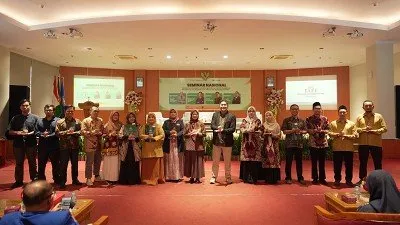

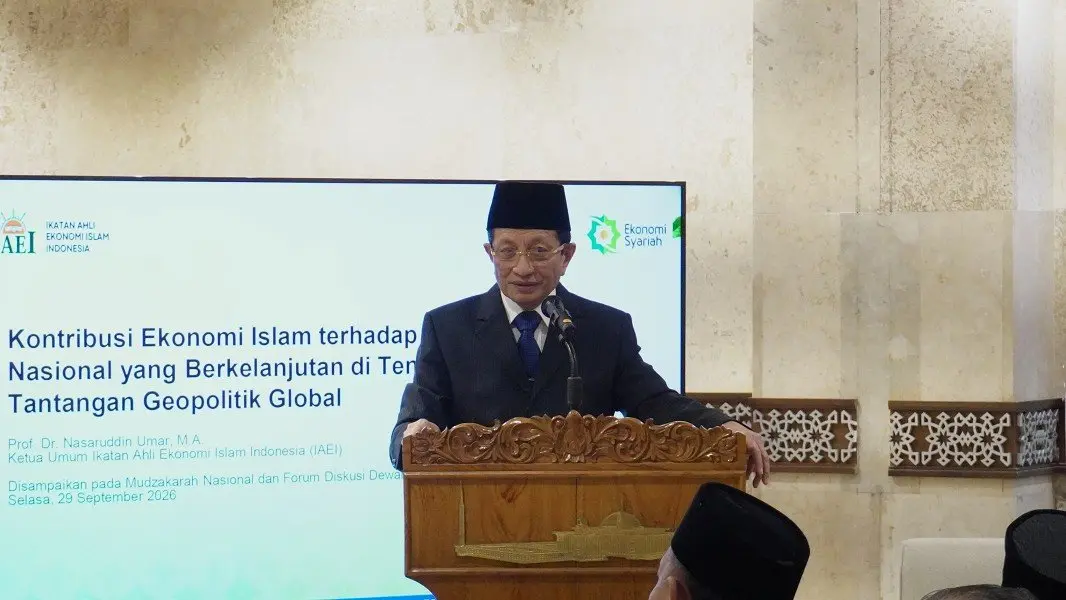
The Chairman of the Indonesian Association of Islamic Economists (IAEI), Prof. Nasaruddin Umar, emphasized that the development of Islamic economics must be built on a foundation of theology, spirituality, ethics, justice, and the public good. He delivered this message during the IAEI National Symposium and Expert Council Discussion Forum held in the VVIP Hall of the Istiqlal Mosque in Jakarta on Tuesday (September 29).
Prof. Nasaruddin noted that Islamic economics must not be limited to material aspects or merely serve to give economic activities an Islamic identity. “Islamic economics should not merely be an economy labeled as Islamic. Islamic values must be the very spirit of the economy itself. There must be balance, justice, and the common good, and none of these should be measured solely in material terms,” said Prof. Nasaruddin.
The Chairman urged the IAEI to develop a roadmap for Islamic economic theology as a foundation for advancing thought and responding to the changing times. In his view, openness to innovation and scientific progress must be accompanied by a clear foundation of values so that the development of the Islamic economy does not lose its identity.
In addition to strengthening the intellectual foundation, Prof. Nasaruddin proposed the establishment of the Community Fund Empowerment Agency (BPDU) to strengthen the management and empowerment of community funds derived from zakat, infaq, sadaqah, waqf, and other religious-social instruments.
In his presentation, Prof. Nasaruddin estimated that the combined potential of community funds amounts to at least Rp1,200 trillion per year. This figure represents potential that needs to be developed through more optimal governance and empowerment, not the current actual amount collected.
“If we can view the full potential of community funds holistically, the amount is enormous. We must channel that potential of Rp1,200 trillion into a force for empowerment, not merely funds that stop at the collection stage,” he emphasized.
At the same time, the IAEI is encouraged to strengthen research and the economic database of the Muslim community, as well as to develop a roadmap for Islamic economic theology as the foundation for the organization’s intellectual development. Through the integration of these three aspects, Islamic economics is guided not to remain merely a normative discourse, but to evolve into an economic ecosystem capable of strengthening productivity, justice, resilience, and the public welfare.