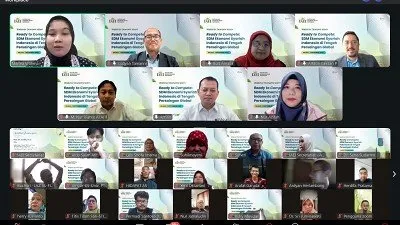

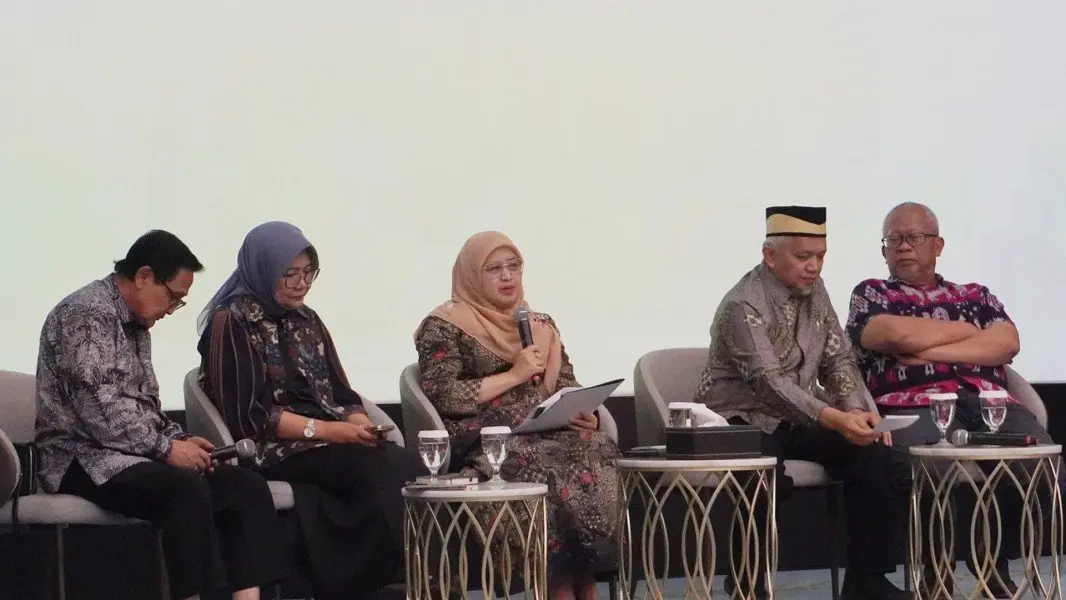
The Central Executive Board of the Indonesian Association of Islamic Economists (IAEI) assesses that the gap between competencies and industry needs remains a major challenge in the development of human resources for the sharia economy and finance in Indonesia. Of the more than 900 Islamic economics degree programs in Indonesia that produce tens of thousands of graduates each year, the industry is said to absorb only about 10–15 percent of them. This was stated by the Chair of the Sharia Economics and Finance Human Resources Development Division, Prof. Euis Amalia, during the webinar “Ready to Compete: Indonesia’s Sharia Economics Human Resources Amid Global Competition,” held online via Zoom on Tuesday, September 1.
According to Prof. Euis Amalia, the development of the Islamic economics and finance industry must go hand in hand with improving the quality of human resources. This gap is influenced by a mismatch between college curricula and the needs of the workforce, which still needs to be strengthened to include soft skills, digital technology and artificial intelligence (AI), language proficiency, and an understanding of international standards in the fields of banking and finance.
Prof. Euis believes that future human resources in the Islamic economy must possess three complementary core competencies. First, technical and digital competencies; second, global perspective, particularly the ability to understand international developments and standards; and third, integrity and morality, which encompass trustworthiness, honesty, and a focus on the greater good.
IAEI encourages strengthening the “link and match” between universities and industry through the development of occupational maps and competency standards for the Islamic economics workforce. “‘Link and match’ does not mean that universities must fully submit to industry demands. Universities must still uphold academic integrity, critical thinking, and a deep understanding of fiqh al-muamalah, while remaining responsive to market dynamics,” emphasized Prof. Euis.
Strengthening human resources is a crucial part of Indonesia’s Islamic economic development agenda. Therefore, collaboration among universities, industry, regulators, professional associations, and certification bodies is necessary to ensure that Islamic economics graduates not only possess academic knowledge but also competencies relevant to industry needs and the ability to compete on a global scale.