
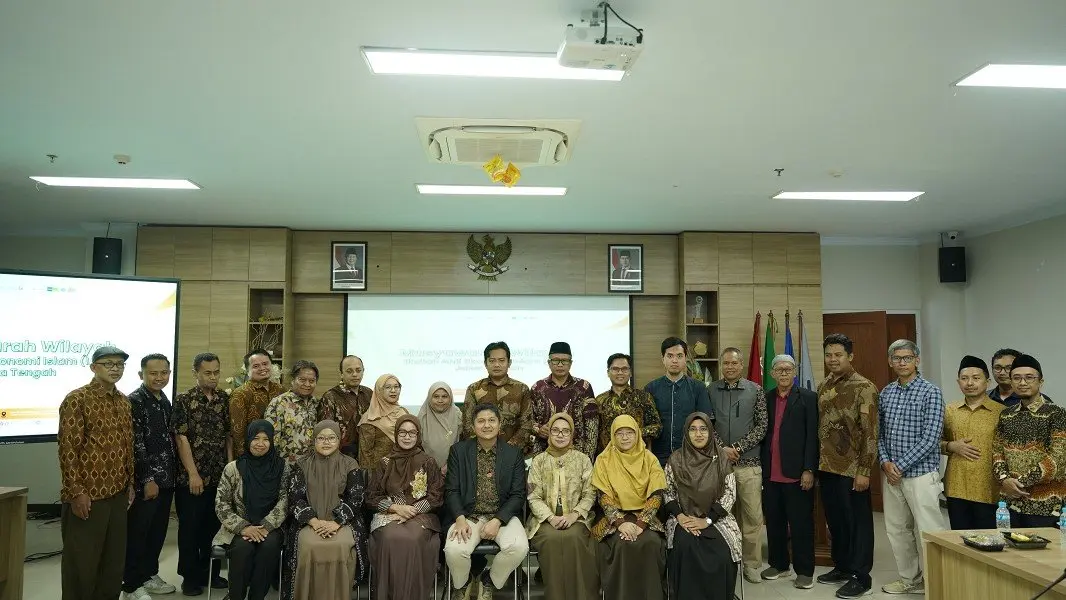
The Regional Executive Board of the Indonesian Association of Islamic Economists (DPW IAEI) Central Java strengthened organizational consolidation through a Regional Conference (Muswil) held at Muhammadiyah University of Purwokerto on Wednesday (9/9). The forum appointed Prof. Naelati Tubastuvi as Chair of the Central Java IAEI Regional Executive Board for the 2026–2031 term, as well as Chair of the Forming Committee responsible for organizing the leadership structure for the upcoming term.
The Regional Congress plays a vital role in ensuring organizational continuity while evaluating the implementation of programs from the previous term. In addition to appointing new leadership, the forum discussed strengthening governance, consolidating local chapters, establishing an activity reporting system, and developing strategies for IAEI’s growth in Central Java.
During the forum, Prof. Naelati presented the accountability report for the previous executive board’s term. She emphasized that the Regional Conference is not merely an organizational mechanism but also a moment to strengthen bonds and foster unity among all elements of IAEI in Central Java.
“The Regional Conference is not merely part of the organizational mechanism; it is also an opportunity to strengthen bonds and foster unity in carrying out IAEI programs,” said Prof. Naelati.
She noted that the development of the IAEI Central Java organization during the previous term was inseparable from the contributions of the entire executive board and the support of past board members. The various foundations that have been laid serve as crucial assets for continuing to strengthen the organization in the coming term.
“The development of the organization’s governance during this term is inseparable from the contributions and support of the entire executive board. The foundations we have built together serve as a stepping stone to continue and improve the performance of IAEI Central Java moving forward,” she said.
One of the key topics discussed at the Regional Conference was the strengthening of the activity reporting system from the branch level to the Regional Executive Board (DPW). Regular reporting is considered essential to ensure that organizational activities are properly documented and to support more orderly, measurable, and integrated governance.
The growth in the number of branches in Central Java was also highlighted as a positive achievement during the forum. The addition of branch offices is seen as a way to expand the organization’s reach while opening up greater opportunities for IAEI to contribute to the development of the Islamic economy and finance in various regions.
However, the growth of the organizational network must be accompanied by improvements in institutional quality. Therefore, periodic evaluations of the existence and performance of branch offices are considered essential to ensure that organizational expansion goes hand in hand with enhanced capacity of the leadership and the effectiveness of work programs.
The Regional Conference also focused on the aspect of organizational quality assurance. This step is necessary to ensure that all elements of the organization adhere to increasingly higher standards of governance and program implementation.
In addition to program reports, the Regional Conference also presented financial reports as part of efforts to strengthen the organization’s transparency and accountability. The forum also served as an opportunity to express appreciation to the previous executive board members for their dedication and contributions to building IAEI Central Java.
The leadership for the 2026–2031 term is expected to build upon the achievements already made while introducing new innovations in organizational development, strengthening Islamic economic literacy, and increasing IAEI’s contribution to the Islamic economic and financial ecosystem in Central Java.
“Moving forward, we want IAEI Central Java to become even more robust—not only institutionally but also through programs that provide tangible benefits for the development of the Islamic economy and finance,” concluded Prof. Naelati.
-extra_small.jpg)