
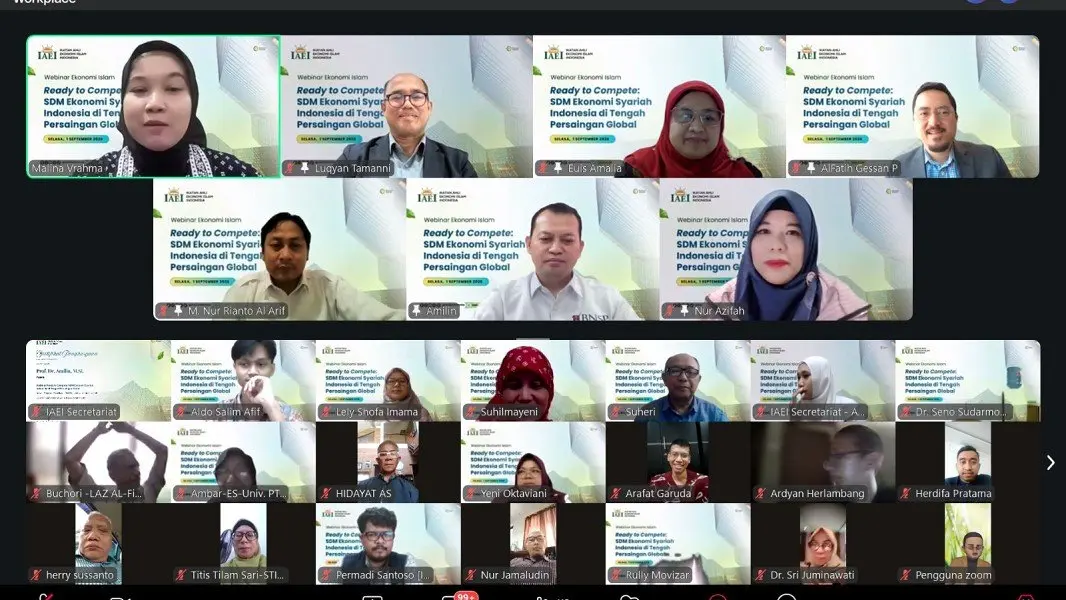
The Central Executive Board of the Indonesian Association of Islamic Economists (IAEI) held a national webinar titled “Ready to Compete: Indonesia’s Sharia Economics Workforce Amid Global Competition” on Tuesday (September 1). Held virtually, this event discussed the challenges and strategies for strengthening human resources in the Islamic economy so they can compete at the global level.
Prof. Euis Amalia, Chair of the Sharia Economics and Finance Human Resources Development Division, noted that the development of Indonesia’s sharia economy must be balanced with human resources of a quality that meets industry needs. “The sharia finance industry still faces a gap between the quality of its human resources and industry demands. Only about 10 percent of graduates are absorbed by the industry,” said Prof. Euis.
According to her, human resources in the Islamic economy must not only master Islamic jurisprudence (fiqh) but also possess soft skills, integrity, a global perspective, and the ability to foster linkages and alignment between universities and the industry.
A similar view was expressed by the Vice Chairman, Prof. Irfan Syauqi Beik, who noted that the quality of human resources is one of the key factors determining Indonesia’s ability to become a global hub for the Islamic economy. He advocated for the development of “double competence”—that is, a mastery of academic knowledge combined with technical skills aligned with industry needs.
“The human resources challenge we face isn’t merely a matter of insufficient education, but also how we can cultivate professionals capable of bridging the gap between theoretical understanding and practical application in the field,” explained Prof. Irfan.
The webinar featured four speakers with complementary perspectives. Prof. Amilin, a Commissioner at the National Professional Standards Agency (BNSP), discussed the importance of professional certification as a bridge between education, industry, and regulators, as well as its role in strengthening competitiveness and facilitating professional mobility in the Islamic economy across industries and countries. Meanwhile, Alfatih Gessan Pananjung, a Senior Lecturer/Manager at the Bahrain Institute of Banking and Finance (BIBF), emphasized the importance of professional readiness to face the global market. He introduced four key competencies: understanding of Sharia, technical skills, digital skills, and global communication.
From an educational perspective, Prof. Mohammad Nur Rianto Al Arif noted that global competition now demands a combination of Islamic knowledge, finance, technology, sustainability, and leadership—achieved through a shift in education from a curriculum-centered approach to a competency-centered one. In closing, Muhammad Imaduddin, a Senior Risk Management Specialist at the Islamic Development Bank (IsDB), shared his insights on career opportunities at international development finance institutions. According to him, career opportunities at IsDB are also open to talent in fields such as data science, climate change, agriculture, and public health.
The discussion also addressed concrete steps that can be taken to enhance competencies and open up career opportunities for Sharia economics professionals at the international level. “Ready to compete” is not just about the growth of the Islamic economy industry, but also about the readiness and recognition of the competencies of the human resources driving it.
Through this webinar, IAEI reaffirmed its commitment to continue strengthening the Islamic economy human resources ecosystem so that Indonesia not only becomes a large market but is also capable of producing talent ready to bring Indonesia’s competencies to the global stage.