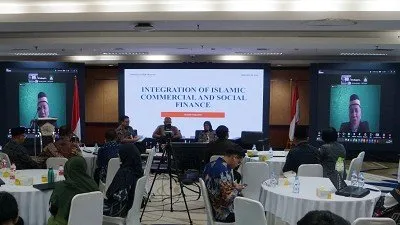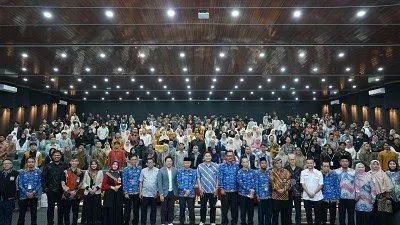

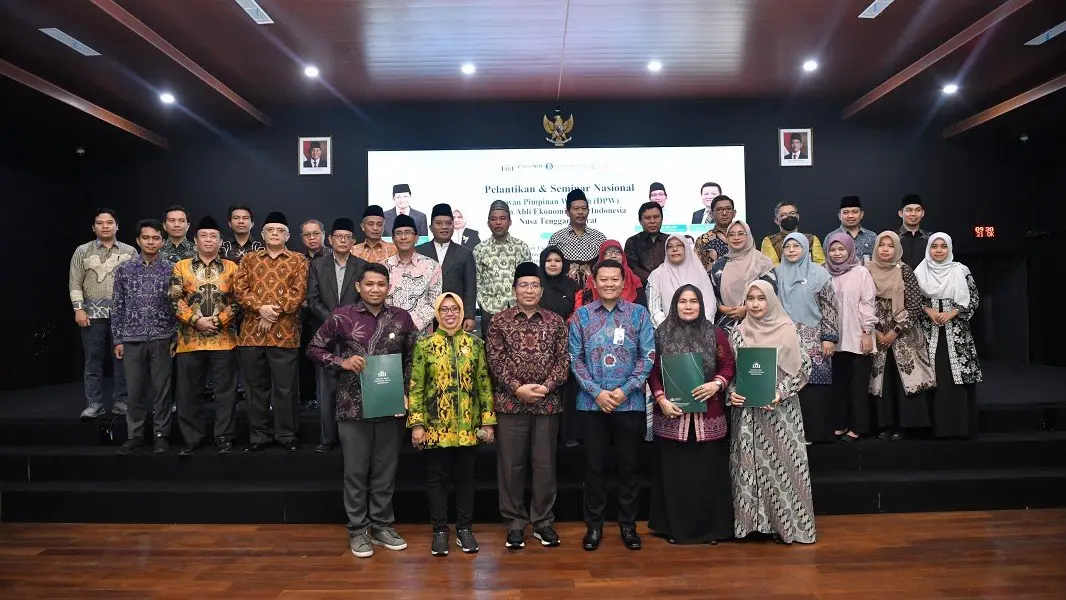
The Central Executive Board of the Indonesian Association of Islamic Economists (IAEI) officially inaugurated the executive board of the IAEI West Nusa Tenggara Regional Executive Board as part of the National Seminar on Strengthening the Sharia Economy and Finance at the Bank NTB Syariah Headquarters in Mataram on Wednesday (October 21). This inauguration marks a step toward strengthening the organization’s efforts to promote the development of Islamic economics and finance and to expand the contributions of academics and practitioners to regional economic development.
The inauguration was led by the Chair of the Islamic Public Finance Development Division, Prof. Waryono Abdul Ghafur, while Dr. Mega Oktaviany from the Division of Organizational Development, Regional Guidance, and Branch Offices read the Inauguration Decree. Prof. Baiq El Badriati officially assumed leadership of the IAEI West Nusa Tenggara Regional Executive Board for the 2026–2031 term.
Prof. El Badriati noted that NTB possesses significant potential in the Islamic economy, ranging from MSMEs, the halal industry, agriculture, livestock, Islamic boarding schools, to halal tourism. This potential must be linked to access to financing, business capacity building, market expansion, and policies that support productivity.
“NTB has immense potential, ranging from the halal industry, SMEs, agriculture, livestock, Islamic boarding schools, to halal tourism. Our challenge is ensuring that all this potential does not remain merely as opportunities, but truly becomes a productive economic force—creating added value, generating jobs, and improving community welfare,” she said.
To realize this vision, IAEI NTB has established five key priorities: strengthening data-driven research and policy recommendations; expanding sharia financing and support for SMEs; developing the halal industry and enhancing the competitiveness of local products; optimizing zakat, infaq, sadaqah, and waqf; and improving the quality of human resources through literacy, entrepreneurship, innovation, and the digitalization of the sharia economy.
The implementation of these priorities will rely on collaboration with local governments, Bank Indonesia, the Financial Services Authority (OJK), Bank NTB Syariah, universities, Islamic boarding schools, and the business community.
“The success of an organization is not merely measured by the number of seminars or studies it produces, but by the extent to which those ideas can be translated into concrete programs with clear indicators and evaluable outcomes,” emphasized Prof. El Badriati.
Through its 2026–2031 leadership term, IAEI NTB is expected to play an increasingly significant role in bridging the gap between academic research, policy, and the needs of business actors. Thus, the Islamic economy can develop as a driver of productivity, value creation, and improved welfare for the people of NTB.